01 January 2013

My Top Ten Most Anticipated Films of 2013

Welcome to the most optimistic post of the year! It's all a spiraling ball of negativity from here on out. Below are the ten films scheduled for release sometime in the next 364 days that have me standing outside at midnight in the theatre of my mind. There is a new rule being implemented this year so please pay close attention. If a film I mentioned in a previous year's list is finally making its way into theatres after any number of delays, it can't make the cut, as I hate repeating myself. Sorry The Grandmaster and To the Wonder. Without further ado, here are your ten 2014 Best Picture Oscar nominees!

10. Upstream Color


There are a few distinct camps centered around Shane Carruth's directorial debut, the mega-low-budget time-travel feature Primer. There are those who find it an impenetrable mess, those that understand it completely (I call this camp "the liars") and those that were puzzled, fascinated and invigorated by it. Count me in as a card-carrying member of Group C. Excepting some work on Rian Johnson's Looper, Upstream Color will be Carruth's first film work in nearly a decade. The film is a love story featuring two people living in an ageless organism. Seeing the film probably won't make it any clearer.

9. Frozen


I may not be obligated to see every single animated Disney film from now on but the CGI Frozen sounds promising enough. Based on the fairy tale The Snow Queen, the film stars Kristen Bell as Anna, an estranged princess who must trek across icy tundra to vanquish the wicked queen. Let's hope that this role is a winner for Bell who hasn't been able to parlay her idiosyncratic talents into anything worthwhile since Veronica Mars. The production art for the film teases a crisp, unforgiving environment and Disney has done all right by itself when adapting the works of Hans Christian Andersen in the past.

8. Queen of the Desert


Werner Herzog and Naomi Watts. Naomi Watts and Werner Herzog. Queen of the Desert is the story of the explorer Gertrude Bell, British attaché in the early 1900s. It is Herzog's first fictional film since Nicolas Cage talked to imaginary iguanas and by all accounts seems like a far more austere affair. (However, don't entirely dismiss the potential for some crazy camel shenanigans.) Sure, detractors will point out that Robert Pattinson is attempting to fill the shoes of Peter O'Toole by playing T.E. Lawrence, and Jude Law is also running around here somewhere, but just remember: Werner Herzog and Naomi Watts.

7. Her


The restlessly inventive Spike Jonze returns to the big screen with this story of a man, played by Joaquin Phoenix, who falls in love with his computer's new operating system. While the premise sounds like the work of frequent Jonze collaborator Charlie Kaufman, this go-around it is borne solely from Jonze's mind. Spike has yet to top the achievement of Being John Malkovich, his feature film debut, but both of his films since then have shown potential and contain several glimpses of the genius more frequently found in his short film work. Samantha Morton, Rooney Mara and Phoenix's co-star in The Master, Amy Adams, also appear.

6. Inside Llewyn Davis


Following their Oscar-winning return with 2007's No Country for Old Men, the Coen brothers went into a steady rhythm of releasing a film per year. But since 2010's enjoyable but rather thin remake of True Grit, the brothers have been silent. Come February that will change with their tale of a Greenwich Village folk singer in the early 1960s. The film is loosely based on the memoirs of Dave Van Ronk and should provide the brothers with a cast of characters crazy enough to rival The Big Lebowski and a soundtrack that might match O Brother, Where Art Thou's ubiquity.

5. Star Trek Into Darkness


Step aside Christopher Nolan and Michael Bay, J.J. Abrams is the real blockbuster auteur of our time. His last two features, Super 8 and the Star Trek reboot, were the best films of their respective summers. Now that he got the pesky introductions out of the way and created that genius parallel timeline so that the new films can go and do whatever the hell they damn well please, the real fun should begin with this Star Trek sequel. How could it not, when the villain is played by Sherlock's own Benedict Cumberbatch? Let's hope this film has more of Simon Pegg's Scotty. Bring on the lens flares.

4. The World's End


Speaking of Simon Pegg, he has finally reunited with his Spaced companions Edgar Wright and Nick Frost to complete the third and final installment of their epic Cornetto trilogy, after Shaun of the Dead and Hot Fuzz. Pegg and Frost play friends who come together in their forties to recreate a pub crawl they completed twenty years ago. Meanwhile, the Earth decides to bring about Armageddon. It is going to be quite a task reaching the heights of wit and hilarity of their first two collaborations but The World's End sounds just epic enough to achieve it.

3. Only Lovers Left Alive


My favorite film of 2009 was Jim Jarmusch's little seen and little loved, The Limits of Control, a glorious synthesis of themes the auteur had been pondering for roughly a decade. The Limits of Control can be seen as a cinematic culmination, a film that wipes the slate clean and leaves the director with a bold, white canvas with which to work with. His new film appears to take that freedom and run with it full throttle. Tilda Swinton and Tom Hiddleston play centuries-old vampires who reunite when Hiddleston, now a musician, becomes depressed by mankind's direction. Who's a what now?

2. The Wind is Rising


Chances are Hayao Miyazaki's new film won't reach American shores before the end of the year but I don't care, I'm throwing it on here anyway. Maybe I'll just hop on over to Tokyo one weekend and catch this. That'll show you. This new animated feature is about the life of Jiro Horikoshi, celebrated designer of World War II fighter planes. The film continues Miyazaki's obsession with flight and rumor has it some of the pilots are anthropomorhized pigs, like the star of Porco Rosso. Expect some exquisitely designed backgrounds, flawless and kinetic action scenes, and some crazy magical stuff you can't wrap your head around.

1. The Tale of Princess Kaguya


Speaking of Studio Ghibli, exactly twenty-five years ago the famed animation company released Miyazaki's masterpiece My Neighbor Totoro on the very same day as studio co-founder Isao Takahata's heartbreaking tale of two brothers struggling to survive in the ruins of World War II, the phenomenal Grave of the Fireflies. To commemorate the greatest day in Japanese cinema history, the studio will be releasing Takahata's new film about a princess borne of bamboo the same day as The Wind is Rising. How can the world be so awesome?

31 December 2012

The Best Movies of 2012


Welcome one and all to the only top ten list you'll ever need! Listed below are all of the films I managed to see in the Year of our Gordon-Levitt 2012. This list is incomplete in a number of respects. One, this may come as quite a shock but I am not a professional film critic. Gasp! This means that I only seek out films that I think would be interesting in the first place, and while I try to have broad range, my scope is much smaller than those who are paid to see everything. So apologies if Battleship is an unknown gem. Secondly, I still have not managed to see a handful of titles generating buzz and that happen to pique some sort of interest in me. For example, I have been planning on seeing Argo for months now but I was too busy watching Chicken Little to get around to it. Meanwhile, something like Zero Dark Thirty has not yet been released in my neck of the woods. Lastly, and this is the biggest problem with this list, I am a man of restrictions, of rules and regulations, and I decided long ago that for a film to qualify it had to have its world premiere in the year in question. If imdb says that a movie opened at a film festival in Argentina on 31 December, 2011, it cannot make the cut. There are several drawbacks to this method, one being that a disproportionate number of foreign films are ineligible for inclusion. This means that one, The Turin Horse or Once Upon a Time in Anatolia are barred from the list, and two, since I know they won't qualify, I put off watching them. Sorry rest of the world! The other problem with my method is that sometimes the best film I saw in the theatre this year, the one I have championed more than any other, also must fall by the wayside. Let it be known that had The Cabin in the Woods been an official 2012 film it would be a lock for best film of the year. It is the only movie I saw three times and the only one that I own the Blu-ray and the Official Visual Companion book on. See what I did there? I wrote a whole list of reasons why my rules suck, then I cheated and named a movie from last year as the best. On with the show!


18. The Campaign
17. John Carter
16. The Hunger Games
15. The Dark Knight Rises
14. Paperman
13. ParaNorman
12. Seven Psychopaths
11. The Queen of Versailles

10. Premium Rush


The perfect late summer drive-in movie. Premium Rush is a twenty-first century chase film set in the world of New York City bike messengers. Joseph Gordon-Levitt plays Wilee--don't worry, the Looney Tunes connection is acknowledged--who is hunted down by the crookedest cop this side of the bad lieutenant (played to the hilt by the great Michael Shannon). Directed by long-time blockbuster screenwriter David Koepp, the film moves at a breathless clip, starting the race in the first reel and rarely letting up until the conclusion. There are some nice cinematic touches throughout, including a method of showing Wilee's thought process as he comes to a dangerous intersection. We see him visualize weaving between two cars only to run into a baby carriage, or hook a left and get hit by a truck. Premium Rush is a breezy feature that straddles a fine line. It continually emphasizes the high stakes but it never takes itself too seriously.

9. Casa de mi Padre


What an ingeniously stupid movie Casa de mi Padre is! Will Ferrell's Spanish-language homage to the telenovela is a ridiculously thin conceit stretched out to the barest of feature film lengths. And it is hilarious. In fact, it might just be Ferrell's most consistently enjoyable film. Ferrell plays the dimwitted son of a ranch owner who must protect their land from the malevolent drug lord Onza, played with relish by Gael García Bernal. Diego Luna hams it up as Ferrell's brother Raul who has gotten himself wrapped up in some shady dealings. The film plays up its threadbare, low budget quality to ludicrous effect, at one point an establishing shot of a city street is filmed with miniatures including a Hot Wheels car. To pad out the film there are all manner of goofy shenanigans including a psychedelic dream sequence and a smorgasbord of slow motion action shots. Casa de mi Padre is a one-of-a-kind creation, a hypothetical doodle taken to its idiotic extreme.

8. Brave


There are a number of wonderful elements in Pixar's Brave. This princess story is a conscious attempt at rewriting the very DNA of a princess story. The headstrong Merida is a mischievous dreamer who would rather scale a mountain by herself than entertain royal visitors. There is no dashing prince and therefore no happily-ever-after romance. It is a film about the bonds between mothers and daughters, a rarity in the boy's world of Hollywood. And as usual, the animation is of a caliber that astounds. Merida's hair is quite possibly the greatest special effect of the year. However, the film is executed with a roteness that is anathema to Pixar's emphasis on engaging story. All of the elements are there but they don't feel inspired. The abundance of slapstick humor with characters running into walls and others showing off their genitals is entirely unfunny. And while the film tries to subvert the foundations of the princess story it still feels overly familiar, hitting many of the same tired beats. It is now two years running that the annual Pixar release was not the best animated film of the year. Regrettably, next year's Monsters University looks more like a hat trick-achieving third contestant than the film that rights the ship.

7. Holy Motors


If a film is made but no one is there to see it, does it still exist? This is one of the questions brought to the surface in Holy Motors, Leos Carax's return to cinema after a decade-plus absence. The film dreamily begins in a cinema full of sleeping (or possibly dead) patrons. The ambient noise of the film awakens Carax, who can't see the forest for the trees and must break through a seemingly solid wall to enter the theatre. From there, the film follows Denis Lavant, in a fantastically fearless performance, as he rides around Paris in a stretch limousine, keeping a number of "appointments". These events require him to disguise himself as, among other things: a beggar woman, a dying old man, a motion-captured sex dragon, and a homeless Munchkin. The movie deals in obfuscation, where masks are constantly worn and nothing is quite what it seems. Carax expertly teases out information, often framing a scene tightly and slowly expanding its field to reveal a new set of clues. The film is deeply referential about the history of cinema, including the director's previous work. Even the name of Lavant's character, Mr. Oscar, can be taken as a nod to the Carax's real name or the Academy Award, or both. If the main character is a surrogate for Carax then there is something to be said about the fact that Oscar dies four times throughout the movie, on three occasions by his own hand, twice in the same scene. Since the film is a series of self-contained vignettes it varies significantly in quality from piece to piece. The greatest sequence is a joyous accordion-laden march through a cathedral, while the worst sees the aforementioned Munchkin kidnapping Eva Mendes, dressing her in a burka and eating her hair. At one point in the film, Lavant is driving around the city in a beat-up hatchback and listening to the song "How Are You Getting Home?" by the band Sparks. In many respects, Holy Motors reminds me of the Mael brothers' inimitable discography. It is clever, expertly constructed, overflowing with ideas, and on occasion, excruciatingly annoying.

6. Looper


Director Rian Johnson pulled off quite a feat with his thoroughly original sci-fi thriller Looper. He found a fascinating new tangent for the overused theme of time travel and used the fantastical conceit as a means of dwelling on age, choices, mortality and morality. He also managed to create a fully realized, futuristic society that appears wholly organic and believeable. And he followed his storytelling muse in a series of intriguing left turns. Somehow a film that starts out with hover cycles, new wonder drugs, and shots of dystopian downtowns, ends up on a quaint little farm and it makes total sense. There are a few cracks in the armor along the way that sidetrack the film from true greatness. First of all, the second half shifts into a lower gear that jars with the fast-paced, overstuffed beginning. While the choice to move events to the farm was interesting--it also gets a little boring. The worst element, however, is the make-up on Joseph Gordon-Levitt, used to make him resemble a twenty-something version of Bruce Willis. Gordon-Levitt does a phenomenal job aping Willis's steely mannerisms on his own and the make-up (especially those unfortunate eyebrows) undermine him every step of the way. Looper is a promising film that doesn't quite reach the level of its abundant potential.

5. Django Unchained


Quentin Tarantino's companion piece to his magnificent Inglourious Basterds is another stylized revisionist revenge tale, this time taking place in the antebellum south where a bounty hunter played by Christoph Waltz picks up Django, a slave played by Jamie Foxx, who can help him catch three wanted men. Once this bounty is acheived the two men team up and eventually make their way to the plantation, ingeniously named Candyland, where Django's wife now resides. The violent retribution at the heart of the picture is more emotionally overwhelming than Basterds thanks to Tarantino's unflinching depiction of the beatings and humiliations meted out on slaves by their white captors. No Tarantino film has ever brought me close to tears before. Django succeeded twice. Unfortunately, in every other respect the film is inferior to the auteur's previous film (and for my money, all of his others as well). The film plays out at an epic length but it does not possess an epic story. There are a couple of tone deaf scenes, particularly a complete piece of filler showing some proto-Klansmen arguing about the effectiveness of their hoods, and one wonders if this ungainly length and disjointed rhythm is an effect of Tarantino losing his career-long editor Sally Menke to an untimely death. Django Unchained is still a fun, exhilarating work with some phenomenal performances (Leonardo DiCaprio's Calvin Candie being one of the best) and a great shoot-out aping the fabulous climax to The Wild Bunch. However, the film has a feeling of deflation about it and the final fifteen minutes doesn't provide quite the satisfaction it is aiming for.

4. The Master


The Master is a glorious, curious, lumbering creation from one of cinema's most electrifying auteurs. It is also the first Paul Thomas Anderson film that failed to surprise me. The picture is a strange hybrid of the writer/director's two previous features, Punch-Drunk Love and There Will Be Blood, both of which work better as a whole than his latest. Tonally, The Master's depiction of two men circling one another under the auspices of religion recalls the push and pull between Daniel Plainview and preacher Eli Sunday in the latter picture. Meanwhile, Joaquin Phoenix's Freddie feels like a frustrated and angry descendent of Punch-Drunk Love's wounded Barry. Both men are struggling with their inner demons and trying to make some sort of connection in a world in which they don't quite fit. Phoenix's performance is the foundation for The Master's success, his commitment to the role unwavering even when the film veers off the rails on a tangential indulgence. If he wins the Oscar over Lincoln frontrunner Daniel Day-Lewis, I would not be the least upset. The first auditing session between Freddie and Philip Seymour Hoffman's Lancaster Dodd may be the single best scene of any film this year. It is a riveting exchange, just two men engaged in a fierce battle of wills that is more exhilarating than any apocalyptic CGI-induced action spectacle. However, as a whole, my sincere appreciation for The Master comes from a distance of detachment. While I can marvel at the performances, the exquisite cinematography, the refined period detail, and superbly unnerving score, I never could quite connect with the material.

3. Wreck-It Ralph


Wreck-It Ralph is pretty awesome.

2. The Avengers


After wandering ever further into the dark abyss of Gothamic grittiness, where men in make-up and rubber suits are made to act out heavy-handed, simplified allegories of today's topical landscape, The Avengers is the first comic book film to tap into the youthful giddiness of the medium since Sam Raimi's fantastic Spider-Man 2 a decade ago. Prior to the film's release, skeptical speculation ran high on the film's ability to successfully integrate so many main characters into a 150 minute-long extravaganza. Nine months removed from its spring release, it is no wonder that writer/director Joss Whedon was able to pull it off. Having proven himself adroit at juggling the multiple storylines of a huge ensemble cast on his wonderful television shows (even Dollhouse!), tackling a super-team of superheroes with their outsized egos and inhuman strengths must have been a delightful challenge for the genius. His ability to cater to the very disparate worlds of the diehard fanboys, the completely uninitiated, and those in between (me) lead to the film's box office bonanza. The Avengers is a breezy, colorful, action-packed joy. Whedon manages to give adequate screen time to his legion of superstars, dishing out witty quips for Robert Downey, Jr., pulpy Shakespearean for Chris Hemsworth, patriotic platitudes for Chris Evans, and he even manages to coax a fine performance out of Scarlett Johannson, who fills Whedon's quota of girl power with aplomb. Her opening scene, an interrupted interrogation, is the best introduction to a superhero in the film. However, it is Mark Ruffalo's definitive portrayal of the Hulk who is responsible for the film's greatest moments. Breathlessly watching the Hulk leap off a building to catch a skyfalling Iron Man is to be a ten-year-old boy again. Incredible.

1. Lincoln


Is there a more divisive 2012 film amongst cinephiles than Steven Spielberg's Lincoln? The war among the geeks is almost as bitter as that played out onscreen in this tense, grey drama. The arguments are certainly nothing new. Spielberg is too obsessed with beauty, he is manipulative, his staging too theatrical, too calculated. These arguments are, for the most part, entirely correct but that does not detract from the fact that Spielberg is a moviemaking maestro whose films recall the grand works of cinematic titans like John Ford or Frank Capra. No one working today could make a movie about this subject matter so invigorating while remaining so accessible. Lincoln wisely narrows its focus on the President to the Herculean passage of the Thirteenth Amendment. Daniel Day-Lewis subtly and gracefully plays Abraham Lincoln like a human being, not a diefied figurehead. His Lincoln is distant and driven, yet taken with folksy, meandering asides. Tony Kushner's deft screenplay manages to weave together these disparate qualities while also giving ample time to flesh out a supporting cast headed by a phenomenal performance from Tommy Lee Jones as Thaddeus Stevens, a progressive who must compromise his ideals to secure the Amendment's passage. By the second half, the film becomes less about Abraham Lincoln and more about the lesser men in his orbit who must decide what side of history they plan to exist on. The only undercooked element of the film is a subplot featuring Joseph Gordon-Levitt as Lincoln's son, Robert. Spielberg is for the most part quite restrained with his direction here. He lets many a scene play out organically, without a need to cut heavily. When he does create some sort of montage it is to wonderful effect. As the Amendment passes, he splits the attention between the raucous uproar in the House and a scene of soldiers hearing the news, until resting on the President, who stands isolated by a window hearing the muted bells outside toll. Lincoln is a film that inspires pride without being cloying or overtly patriotic. It shows that democracy is a messy, arduous business but that it has the power to transform lives.


30 December 2012

The Disney 52 Ranked

This post is equipped with Disney's FastPlay. Your list and a selection of bonus features will begin automatically. To bypass FastPlay, press the Main Menu button at any time. FastPlay will begin in a moment...


Twelve months ago I embarked on an endeavor of absolutely ridiculous proportions, an enormous undertaking for a man of my committed leisure, in an effort to both deepen my knowledge of a specific cinematic canon and force myself to write more consistently. Over the course of 2012, this Disney Daze project became many things to me. At times it was a blast, occasionally it became a chore, and once or twice it was a genuine surprise, but the project remained steadfastly worthwhile throughout. I finally got to watch a few great films that I had heard such wonderful things about (Lilo & Stitch) and I unearthed a few unexpected gems (The Hunchback of Notre Dame). Indeed there were long stretches of dreck but I learned to seek out the brief and subtle moments of inspiration tucked away in otherwise abysmal creations.


I am gratified to know that I can sustain enthusiasm for such a long term, relatively mammoth project. I typed out well over 50,000 words this year analyzing roughly three straight days of cartoons and that has to count for something. I'm still not quite sure what, but something dang it! Lately I've been toying with the idea of editing, expanding, and rewriting these posts and maybe turning it into a cheap Kindle book or something. That is a project for a fresh-faced new year. In the meantime, I present the fifty-two theatrically-released Disney animated features in order of their quality.


1. Snow White and the Seven Dwarfs
2. Dumbo
3. Sleeping Beauty
4. Pinocchio
5. Bambi
6. Lady and the Tramp
7. Fantasia
8. Alice in Wonderland
9. The Many Adventures of Winnie the Pooh
10. Lilo & Stitch


11. The Little Mermaid
12. Peter Pan
13. The Adventures of Ichabod and Mr. Toad
14. The Jungle Book
15. The Hunchback of Notre Dame
16. Make Mine Music
17. The Princess and the Frog
18. Beauty and the Beast
19. Wreck-It Ralph
20. The Aristocats


21. Winnie the Pooh
22. One Hundred and One Dalmatians
23. The Black Cauldron
24. Robin Hood
25. Tangled
26. Cinderella
27. Atlantis: The Lost Empire
28. Aladdin
29. The Lion King
30. Fantasia 2000


31. Saludos Amigos
32. Treasure Planet
33. Bolt
34. Tarzan
35. The Sword in the Stone
36. Mulan
37. Brother Bear
38. Pocahontas
39. The Fox and the Hound
40. Melody Time


41. The Great Mouse Detective
42. The Rescuers Down Under
43. Fun and Fancy Free
44. Meet the Robinsons
45. The Three Caballeros
46. Home on the Range
47. Dinosaur
48. The Rescuers
49. The Emperor's New Groove
50. Oliver & Company
51. Hercules
52. Chicken Little


29 December 2012

Disney Daze: Week 52: Wreck-It Ralph

In 2012, this exhausted reporter watched, in chronological order, all of Walt Disney Studios' 52 theatrically-released animated features, one per week.


The ripe idea for a film based on video game culture had been kicking around the Disney studios since the 1980s. For many years the project would lie dormant before another team was given a crack at it, making various inroads with a production that would eventually be shelved. Finally two veterans of The Simpsons, directors Rich Moore and Jim Reardon cracked the story with help from Phil Johnston. (Reardon also co-wrote Pixar's masterpiece WALL*E with Andrew Stanton.) Moore took over direction of the subsequent film, now called Wreck-It Ralph, which would become his first theatrical feature. The Simpsons connection was apropos because Wreck-It Ralph crams in a plethora of visual gags and moves at the fluid clip of a crackerjack television episode.


The film tells the story of the titular character, the Donkey Kong-esque villain of an 8-bit arcade game who longs to be a hero. To accomplish this he leaves his own game and enters, in succession, a violent first-person shooter and a candy-themed racing game, both of which were developed long after his simple game and provide a host of complex issues to overcome. The production design in the film is a marvel, with the filmmakers having to develop not one or two, but several unique worlds with their own styles and rules. The creation of Sugar Rush, the racing game in which most of the film unfolds, is so fully realized that it feels like a game one would have played endlessly if it truly existed. 


The world extends outward to Game Central Station, a power strip that serves as a transit depot for the characters who hop over to the tavern from the game Tapper to down a cold one after a long day's work or attend a villains' support group. Populated throughout these scenes are references and characters from a host of famous video games including Sonic the Hedgehog, Street Fighter, and Q*Bert. These cameos are more than just winking asides to the audience--although there are several of those as well--they make the world of the film feel much more real. It is akin to Toy Story's wise inclusion of Mr. Potato Head or Slinky Dog.


Besides the detailed and imaginative design, the great achievement in animation with Wreck-It Ralph comes from the movement of the characters. For each game, the animators created a different style based on the game's vintage and by extension its computing capacity. This is most obvious in the old-school world of Fix-It Felix where the town's residents, even when acting in the three-dimensional world of the film, move with the abrupt jerkiness of an 8-bit, blocky design. 


The voice work is mostly provided by Hollywood celebrities who bring their proscribed personalities to the creations as shorthand for their characters. Some of these efforts work, like star John C. Reilly's loveable lunkheaded portrayal of Ralph; while others, like the altruistic hero of his game Fix-It Felix, voiced by Jack McBrayer, does not. Felix just feels like a cartoon extension of McBrayer's do-gooder on 30 Rock. It is nothing more than a distraction. Sarah Silverman plays a glitchy brat Vannelope in Sugar Rush and she brings a wounded and surprisingly deep performance to the girl. Also of note is Alan Tudyk's channeling of the great Ed Wynn, sounding like a deliriously loopy cousin of Disney's the Mad Hatter.


The worst aspect of the film comes from the songs which are loud, bland filler that would slot in just fine alongside the other disposable pop pumped out on the Radio Disney airwaves. Thankfully, there are only a couple of these egregious earworms littered across the film. For example, a scene of emotional triumph when Vannelope races her first car is completely sabotaged by a cast-off Rihanna track called ironically "Shut Up and Drive". The worst track however is by Buckner & Garcia, novelty artists who infamously composed the song "Pac-Man Fever" and try to achieve a similar feat with "Wreck It, Wreck-It Ralph" whose only saving grace is that it plays over the closing credits. 


Wreck-It Ralph is an eye-popping, candy-coated thrill ride through the vibrantly dense world of video games. It takes a cue from the Pixar formula and works incredibly hard at providing a potentially frivolous film with a genuine heart. The emotional crisis at the film's center is truly wrenching and entirely earned. It is followed by a well-conceived, action-packed climax that ties a number of the film's threads together and brings about a wholly satisfying conclusion. Disney waited a quarter century to bring Wreck-It Ralph to the screen. In that time, video games and their culture moved from the fringes and became a well-respected art form. The filmmakers managed to honor this medium and create a crowd-pleasing piece of art in the process.  

28 December 2012

Cinematic Capsules: December 2012

The Killers (1964)


This post-noir from director Don Siegel is the second cinematic adaptation of an Ernest Hemingway short story. Lee Marvin and Clu Gulager play hitmen investigating the origin of their recently completed job. Marvin is troubled by the large pay-out and the fact that their victim, a school teacher for the blind, played by John Cassevetes, didn't try and fight or run for his life. Marvin and Gulager trace Cassevetes' life as a race car driver and the subsequent trouble he gets embroiled in after falling for Angie Dickinson's rich, thrill-seeking dame. The three leads, Marvin, Cassavetes, and Dickinson are all superb. Dickinson in particular deserves praise for selling her romance with the lowly racer. Deep down he (and the audience) know that she's no good but we all desperately want to believe her. The supporting cast, including Gulager and a villainous Ronald Reagan (in his final film role), are undeniably weak by comparison. The film's conceit of having each person the hitmen interrogate tell a long story about Cassevetes in flashback slows the pacing down and the film feels longer than its ninety minutes. But the film is entertaining enough and features a wonderful closing line from the tough-as-nails Marvin.

Tokyo Story (1953)


Recently topping this decade's Sight and Sound director's poll as the greatest film of all time, Yasujiro Ozu's elegantly elemental picture is unequivocally worthy of the esteemed accolade. Telling the story of an elderly couple travelling to the big city to see their self-absorbed progeny, the film quietly depicts the restrained resignation of two people who have become ignored and unappreciated. We get to intimately know this family's history as the parents are shuttled between one preoccupied child and another. Ozu's square and static compositions are subtly evocative, boxing people into their homes and lives. The performances are uniformly fantastic, with the work of Chishu Ryu as the thoughtful patriarch serving as the film's firm foundation. Watching Tokyo Story is an experience in cinematic revelation. The magic that Ozu weaves, telling a simple story with such a subtle style is a feat of much more monumental achievement than most highwire genre pictures. Tokyo Story is a captivating, beautifully meditative film full of sorrow and regret that is evermore emotionally effective for its outright refusal to cater to the manipulations of melodrama.    

Island of Lost Souls (1932)


Not as well known as the bigger names in Universal's famed renaissance of cinematic horror but just as creepy, Erle C. Kenton's adaptation of H.G. Wells' novel The Island of Dr. Moreau stars the magnificent Charles Laughton as the titular doctor who lives in the remote tropics with his creations, a society of human/animal hybrids who attempt to forgo their baser instincts and become civilized. The rallying cry, "are we not men?" would be an inspiration for some art-damaged weirdos from Akron, Ohio who in the mid-seventies formed a band called DEVO and subsequently stole the phrase for their iconic debut album. The film has a number of classic horror elements that signify its place in the Universal lineage. There are some truly spooky shots of a horde of creatures running through the jungle, their outsized shadows climbing the walls of Moreau's compound. And it wouldn't be a Universal film without a crazed mob running with torches. From a technical standpoint, these scenes possess some subtly stunning camera work with a couple of really fluid crane shots looking down on the monster mob. The scariest element of the film however is Laughton, who plays Moreau as a civilized, sinister dandy. His Cheshire grin peaking out from the darkness is the greatest special effect in the film. He runs circles around the rest of the cast, who rarely elevate themselves beyond props. Bela Lugosi does a decent job as the hairy leader of the monsters though.

27 December 2012

Disney Daze: Week 51: Winnie the Pooh

In 2012, this intrepid reporter plans to watch, in chronological order, all of Walt Disney Studios' 52 theatrically-released animated features, one per week.


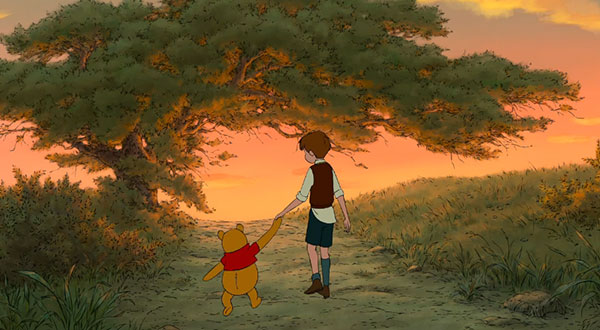
1977's The Many Adventures of Winnie the Pooh is one of the most important films in the Walt Disney canon. Not only is it an adorable animated feature with brilliant voice work, wonderful songs, and a surprisingly melancholy air, it was also the nexus point for the global merchandising phenomenon that is Winnie the Pooh. The tubby little cubby is one of the hugest cash cows for the Disney corporation which--considering its treasure chest of properties so deep and wide--is saying a lot. So it is no wonder that the studio decided to commission a new animated feature based on the works of author A.A. Milne. Executive producer John Lasseter said that they wanted to create a film that would "transcend generations". This is in response partly to the company's more recent work which saw the silly old bear cavorting around on television sets in a computer-generated body and wearing a mask like a common burglar. It was also a directive to steer the film away from the kinds of hackneyed choices made by many contemporary animated films, by both Disney and their competitors, to go for cheap jokes, tired clichés, and up-to-the-minute references. 


Winnie the Pooh opens much like the 1977 film by entering a live action bedroom belonging to the young boy Christopher Robin. There we see stuffed animal versions of the Hundred Acre Wood inhabitants. (The credits will inform us that the dolls were provided courtesy of the Disney Store. Synergy!) The camera finally rests on our titular star who sits patiently in a chair with an old book next to him. The tome opens and the upper class British tones of John Cleese begin to narrate our trip back to the home of these cute characters. At this point we get one of the thankfully few and easily the most egregious "updates" to the property as hipster royalty Zooey Deschanel and M. Ward perform a clunky arrangement of the classic Winnie the Pooh theme. Their version sounds like a cross between NPR filler and what I assume a Raffi record sounds like sung by a cool chanteuse.


In fact, the film's most underwhelming element overall is the music, especially when compared with the masterpiece that is Robert and Richard Sherman's soundtrack for the original. Nothing fares as bad as the reworked theme song, in fact Deschanel herself returns later with vocals on a couple of other numbers and she sounds just fine. However, most of the newly written tunes are thin and rather trite. The composers here, married musicians Kristen Anderson-Lopez and Robert Lopez write nothing truly memorable. It is telling that Tigger's brief reprise of his famous theme song is the catchiest thing in the film. Certainly part of this is nostalgia but it is also testament to a heck of a good tune.


The look and feel of the film is nearly identical to the thirty-five-year-old original. The characters live in a stylized forest that recalls the beautiful etchings contained within the book. They also still interact with the book itself, jumping from page to page, talking to the narrator (their very dialogue typed out below them) and in one truly inspired moment, use a letter ladder, made out of the words "letter ladder", to climb their way out of a pit. For all of its celebration of reading and words, however, it is a bit disconcerting how much emphasis the film puts on the characters misspelling words. In the original film, it was endearing to see so many pots scrawled with their own interpretations of the word "honey". In this feature though, nearly every single word on every sign is misspelled. Owl proudly writes T-A-E-L on a chalkboard serving as a makeshift tail for Eeyore, even going so far as to announce each letter as he scratches them on the board.


To be fair, this misunderstanding of words leads to one of the film's greatest sequences when Owl--who for all of his intellectual affectations and rich vocabulary proves himself time and again as the dumbest character in the film--misreads a note from Christopher Robin stating that he will be "back soon" as "Backson". The Backson becomes a horrible monster conjured up by the character's collective imaginations as a beast who makes you sleep late, puts holes in your socks and all other manner of horrible things. Eeyore's chalkboard tail comes into play here as Owl creates an artist's rendering of the creature and the animation adopts a childish pastel chalk design. Paired with the Lopez couple's best song, we get a very fun, imaginative sequence that recalls the original's famed Heffalumps and Woozles section.


Another great reverie in the film occurs when a hungry, hallucinating Pooh starts seeing imaginary honey pots everywhere. Every other word out of his friend's mouths turns into "honey" as well, until he finds himself in a fantastical Busby Berkeley-esque wonderland with flowing rivers, spouting fountains, and dancing Pooh bears all made out of honey. It is reminiscent of the "Malkovich Malkovich" scene in Being John Malkovich which a weird and wonderful thing to say about a Disney film. The scene ends with a dejected Pooh discovering he is just playing in the mud.


The voicework in the film is almost uniformly phenomenal. The greatest praise is due to Jim Cummings, who voices both Tigger and Pooh, somehow managing to perfectly replicate the tones of both very disparate characters. Bud Luckey nails Eeyore's defeated disposition, especially when he tells everyone they're all going to die. Even the celebrity voices such as Cleese and Craig Ferguson's Owl are perfectly integrated into the cinematic world. The only weak spot is Tom "Spongebob" Kenny's voicing of Rabbit which just feels wrong. It fails to captures Rabbit's uptight prissiness.


Like its namesake, Winnie the Pooh is remarkably short. Excluding the charming closing credits that play out over images of the live action stuffed animals posed in scenes from earlier in the film, Winnie the Pooh is less than an hour long. (To pad out the running time, the film was paired with another welcome throwback, the cartoon short The Ballad of Nessie which recalls some of the great Disney work from the 1950s, like Susie the Little Blue Coupe.) Originally the film was to be made up of five Milne stories which would have brought the running time closer to an hour and a half, but it was wisely pared down to just three. The film's brevity is to its strength because the narrative's highly episodic nature can at times feel like it is hanging on by a thread. 


Truly there is something special about a film whose plot hinges on finding a tail for a toy donkey and the closest approximation to a villain is a red ballon. Winnie the Pooh is a delightfully quaint feature with very little to prove. This allows the story to follow its own idyllic little paths and relish the smaller joys of life, be they friendship, imagination, or hunny. I mean, honey. The film does not reach the artistic heights of its forefather, due in part to a twenty-first century sense of rhythm which takes out much of the original film's meditative power thanks to an increased need for shorter cuts. But these are lofty aspirations for a film that doggedly pursues the quieter road. Except when Tiggers are around.