Showing posts with label disney daze. Show all posts

30 December 2012

The Disney 52 Ranked

This post is equipped with Disney's FastPlay. Your list and a selection of bonus features will begin automatically. To bypass FastPlay, press the Main Menu button at any time. FastPlay will begin in a moment...


Twelve months ago I embarked on an endeavor of absolutely ridiculous proportions, an enormous undertaking for a man of my committed leisure, in an effort to both deepen my knowledge of a specific cinematic canon and force myself to write more consistently. Over the course of 2012, this Disney Daze project became many things to me. At times it was a blast, occasionally it became a chore, and once or twice it was a genuine surprise, but the project remained steadfastly worthwhile throughout. I finally got to watch a few great films that I had heard such wonderful things about (Lilo & Stitch) and I unearthed a few unexpected gems (The Hunchback of Notre Dame). Indeed there were long stretches of dreck but I learned to seek out the brief and subtle moments of inspiration tucked away in otherwise abysmal creations.


I am gratified to know that I can sustain enthusiasm for such a long term, relatively mammoth project. I typed out well over 50,000 words this year analyzing roughly three straight days of cartoons and that has to count for something. I'm still not quite sure what, but something dang it! Lately I've been toying with the idea of editing, expanding, and rewriting these posts and maybe turning it into a cheap Kindle book or something. That is a project for a fresh-faced new year. In the meantime, I present the fifty-two theatrically-released Disney animated features in order of their quality.


1. Snow White and the Seven Dwarfs
2. Dumbo
3. Sleeping Beauty
4. Pinocchio
5. Bambi
6. Lady and the Tramp
7. Fantasia
8. Alice in Wonderland
9. The Many Adventures of Winnie the Pooh
10. Lilo & Stitch


11. The Little Mermaid
12. Peter Pan
13. The Adventures of Ichabod and Mr. Toad
14. The Jungle Book
15. The Hunchback of Notre Dame
16. Make Mine Music
17. The Princess and the Frog
18. Beauty and the Beast
19. Wreck-It Ralph
20. The Aristocats


21. Winnie the Pooh
22. One Hundred and One Dalmatians
23. The Black Cauldron
24. Robin Hood
25. Tangled
26. Cinderella
27. Atlantis: The Lost Empire
28. Aladdin
29. The Lion King
30. Fantasia 2000


31. Saludos Amigos
32. Treasure Planet
33. Bolt
34. Tarzan
35. The Sword in the Stone
36. Mulan
37. Brother Bear
38. Pocahontas
39. The Fox and the Hound
40. Melody Time


41. The Great Mouse Detective
42. The Rescuers Down Under
43. Fun and Fancy Free
44. Meet the Robinsons
45. The Three Caballeros
46. Home on the Range
47. Dinosaur
48. The Rescuers
49. The Emperor's New Groove
50. Oliver & Company
51. Hercules
52. Chicken Little


29 December 2012

Disney Daze: Week 52: Wreck-It Ralph

In 2012, this exhausted reporter watched, in chronological order, all of Walt Disney Studios' 52 theatrically-released animated features, one per week.


The ripe idea for a film based on video game culture had been kicking around the Disney studios since the 1980s. For many years the project would lie dormant before another team was given a crack at it, making various inroads with a production that would eventually be shelved. Finally two veterans of The Simpsons, directors Rich Moore and Jim Reardon cracked the story with help from Phil Johnston. (Reardon also co-wrote Pixar's masterpiece WALL*E with Andrew Stanton.) Moore took over direction of the subsequent film, now called Wreck-It Ralph, which would become his first theatrical feature. The Simpsons connection was apropos because Wreck-It Ralph crams in a plethora of visual gags and moves at the fluid clip of a crackerjack television episode.


The film tells the story of the titular character, the Donkey Kong-esque villain of an 8-bit arcade game who longs to be a hero. To accomplish this he leaves his own game and enters, in succession, a violent first-person shooter and a candy-themed racing game, both of which were developed long after his simple game and provide a host of complex issues to overcome. The production design in the film is a marvel, with the filmmakers having to develop not one or two, but several unique worlds with their own styles and rules. The creation of Sugar Rush, the racing game in which most of the film unfolds, is so fully realized that it feels like a game one would have played endlessly if it truly existed. 


The world extends outward to Game Central Station, a power strip that serves as a transit depot for the characters who hop over to the tavern from the game Tapper to down a cold one after a long day's work or attend a villains' support group. Populated throughout these scenes are references and characters from a host of famous video games including Sonic the Hedgehog, Street Fighter, and Q*Bert. These cameos are more than just winking asides to the audience--although there are several of those as well--they make the world of the film feel much more real. It is akin to Toy Story's wise inclusion of Mr. Potato Head or Slinky Dog.


Besides the detailed and imaginative design, the great achievement in animation with Wreck-It Ralph comes from the movement of the characters. For each game, the animators created a different style based on the game's vintage and by extension its computing capacity. This is most obvious in the old-school world of Fix-It Felix where the town's residents, even when acting in the three-dimensional world of the film, move with the abrupt jerkiness of an 8-bit, blocky design. 


The voice work is mostly provided by Hollywood celebrities who bring their proscribed personalities to the creations as shorthand for their characters. Some of these efforts work, like star John C. Reilly's loveable lunkheaded portrayal of Ralph; while others, like the altruistic hero of his game Fix-It Felix, voiced by Jack McBrayer, does not. Felix just feels like a cartoon extension of McBrayer's do-gooder on 30 Rock. It is nothing more than a distraction. Sarah Silverman plays a glitchy brat Vannelope in Sugar Rush and she brings a wounded and surprisingly deep performance to the girl. Also of note is Alan Tudyk's channeling of the great Ed Wynn, sounding like a deliriously loopy cousin of Disney's the Mad Hatter.


The worst aspect of the film comes from the songs which are loud, bland filler that would slot in just fine alongside the other disposable pop pumped out on the Radio Disney airwaves. Thankfully, there are only a couple of these egregious earworms littered across the film. For example, a scene of emotional triumph when Vannelope races her first car is completely sabotaged by a cast-off Rihanna track called ironically "Shut Up and Drive". The worst track however is by Buckner & Garcia, novelty artists who infamously composed the song "Pac-Man Fever" and try to achieve a similar feat with "Wreck It, Wreck-It Ralph" whose only saving grace is that it plays over the closing credits. 


Wreck-It Ralph is an eye-popping, candy-coated thrill ride through the vibrantly dense world of video games. It takes a cue from the Pixar formula and works incredibly hard at providing a potentially frivolous film with a genuine heart. The emotional crisis at the film's center is truly wrenching and entirely earned. It is followed by a well-conceived, action-packed climax that ties a number of the film's threads together and brings about a wholly satisfying conclusion. Disney waited a quarter century to bring Wreck-It Ralph to the screen. In that time, video games and their culture moved from the fringes and became a well-respected art form. The filmmakers managed to honor this medium and create a crowd-pleasing piece of art in the process.  

27 December 2012

Disney Daze: Week 51: Winnie the Pooh

In 2012, this intrepid reporter plans to watch, in chronological order, all of Walt Disney Studios' 52 theatrically-released animated features, one per week.


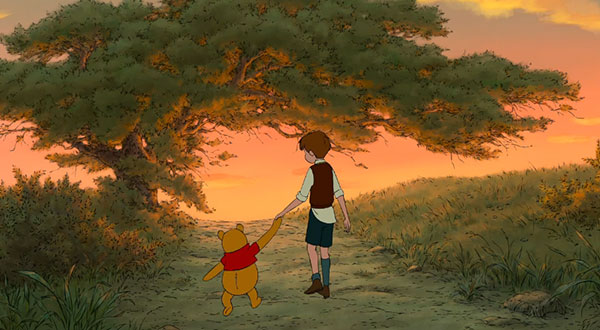
1977's The Many Adventures of Winnie the Pooh is one of the most important films in the Walt Disney canon. Not only is it an adorable animated feature with brilliant voice work, wonderful songs, and a surprisingly melancholy air, it was also the nexus point for the global merchandising phenomenon that is Winnie the Pooh. The tubby little cubby is one of the hugest cash cows for the Disney corporation which--considering its treasure chest of properties so deep and wide--is saying a lot. So it is no wonder that the studio decided to commission a new animated feature based on the works of author A.A. Milne. Executive producer John Lasseter said that they wanted to create a film that would "transcend generations". This is in response partly to the company's more recent work which saw the silly old bear cavorting around on television sets in a computer-generated body and wearing a mask like a common burglar. It was also a directive to steer the film away from the kinds of hackneyed choices made by many contemporary animated films, by both Disney and their competitors, to go for cheap jokes, tired clichés, and up-to-the-minute references. 


Winnie the Pooh opens much like the 1977 film by entering a live action bedroom belonging to the young boy Christopher Robin. There we see stuffed animal versions of the Hundred Acre Wood inhabitants. (The credits will inform us that the dolls were provided courtesy of the Disney Store. Synergy!) The camera finally rests on our titular star who sits patiently in a chair with an old book next to him. The tome opens and the upper class British tones of John Cleese begin to narrate our trip back to the home of these cute characters. At this point we get one of the thankfully few and easily the most egregious "updates" to the property as hipster royalty Zooey Deschanel and M. Ward perform a clunky arrangement of the classic Winnie the Pooh theme. Their version sounds like a cross between NPR filler and what I assume a Raffi record sounds like sung by a cool chanteuse.


In fact, the film's most underwhelming element overall is the music, especially when compared with the masterpiece that is Robert and Richard Sherman's soundtrack for the original. Nothing fares as bad as the reworked theme song, in fact Deschanel herself returns later with vocals on a couple of other numbers and she sounds just fine. However, most of the newly written tunes are thin and rather trite. The composers here, married musicians Kristen Anderson-Lopez and Robert Lopez write nothing truly memorable. It is telling that Tigger's brief reprise of his famous theme song is the catchiest thing in the film. Certainly part of this is nostalgia but it is also testament to a heck of a good tune.


The look and feel of the film is nearly identical to the thirty-five-year-old original. The characters live in a stylized forest that recalls the beautiful etchings contained within the book. They also still interact with the book itself, jumping from page to page, talking to the narrator (their very dialogue typed out below them) and in one truly inspired moment, use a letter ladder, made out of the words "letter ladder", to climb their way out of a pit. For all of its celebration of reading and words, however, it is a bit disconcerting how much emphasis the film puts on the characters misspelling words. In the original film, it was endearing to see so many pots scrawled with their own interpretations of the word "honey". In this feature though, nearly every single word on every sign is misspelled. Owl proudly writes T-A-E-L on a chalkboard serving as a makeshift tail for Eeyore, even going so far as to announce each letter as he scratches them on the board.


To be fair, this misunderstanding of words leads to one of the film's greatest sequences when Owl--who for all of his intellectual affectations and rich vocabulary proves himself time and again as the dumbest character in the film--misreads a note from Christopher Robin stating that he will be "back soon" as "Backson". The Backson becomes a horrible monster conjured up by the character's collective imaginations as a beast who makes you sleep late, puts holes in your socks and all other manner of horrible things. Eeyore's chalkboard tail comes into play here as Owl creates an artist's rendering of the creature and the animation adopts a childish pastel chalk design. Paired with the Lopez couple's best song, we get a very fun, imaginative sequence that recalls the original's famed Heffalumps and Woozles section.


Another great reverie in the film occurs when a hungry, hallucinating Pooh starts seeing imaginary honey pots everywhere. Every other word out of his friend's mouths turns into "honey" as well, until he finds himself in a fantastical Busby Berkeley-esque wonderland with flowing rivers, spouting fountains, and dancing Pooh bears all made out of honey. It is reminiscent of the "Malkovich Malkovich" scene in Being John Malkovich which a weird and wonderful thing to say about a Disney film. The scene ends with a dejected Pooh discovering he is just playing in the mud.


The voicework in the film is almost uniformly phenomenal. The greatest praise is due to Jim Cummings, who voices both Tigger and Pooh, somehow managing to perfectly replicate the tones of both very disparate characters. Bud Luckey nails Eeyore's defeated disposition, especially when he tells everyone they're all going to die. Even the celebrity voices such as Cleese and Craig Ferguson's Owl are perfectly integrated into the cinematic world. The only weak spot is Tom "Spongebob" Kenny's voicing of Rabbit which just feels wrong. It fails to captures Rabbit's uptight prissiness.


Like its namesake, Winnie the Pooh is remarkably short. Excluding the charming closing credits that play out over images of the live action stuffed animals posed in scenes from earlier in the film, Winnie the Pooh is less than an hour long. (To pad out the running time, the film was paired with another welcome throwback, the cartoon short The Ballad of Nessie which recalls some of the great Disney work from the 1950s, like Susie the Little Blue Coupe.) Originally the film was to be made up of five Milne stories which would have brought the running time closer to an hour and a half, but it was wisely pared down to just three. The film's brevity is to its strength because the narrative's highly episodic nature can at times feel like it is hanging on by a thread. 


Truly there is something special about a film whose plot hinges on finding a tail for a toy donkey and the closest approximation to a villain is a red ballon. Winnie the Pooh is a delightfully quaint feature with very little to prove. This allows the story to follow its own idyllic little paths and relish the smaller joys of life, be they friendship, imagination, or hunny. I mean, honey. The film does not reach the artistic heights of its forefather, due in part to a twenty-first century sense of rhythm which takes out much of the original film's meditative power thanks to an increased need for shorter cuts. But these are lofty aspirations for a film that doggedly pursues the quieter road. Except when Tiggers are around. 

24 December 2012

Disney Daze: Week 50: Tangled

In 2012, this intrepid reporter plans to watch, in chronological order, all of Walt Disney Studios' 52 theatrically-released animated features, one per week.


Fifty films in, it is a bit of surprise that Disney had not already co-opted the Brothers Grimm tale of Rapunzel for their abundant animated arsenal. One would expect the Grimm reserves, as well as those of Hans Christian Andersen, to be pilfered completely by now. What, pray tell, will the studio do when these sources of inspiration are all dried up? Certainly, this is a crisis for another day. 2010's Tangled opens with some glib narration by dashing rogue and flashy scoundrel Flynn Rider, who tells the tale of how a centuries-old woman stole the only child of benevolent royalty to harness the girl's magical hair, which has the power to restore youth and heal all wounds. The smarminess of Flynn at the outset is a little off-putting as he plays the cad and cracks wise underneath a calculated "smolder". Luckily, his cockiness doesn't reach the levels of sleaze emanated from say, Kuzco, in The Emperor's New Groove, and it soon falls by the wayside as he falls for Rapunzel and her long locks. He meets her after stealing the crown from the castle and falling upon her tower while looking for a place to hide.


The beautiful Rapunzel is fairly well-adjusted considering she has been locked inside a single room for all eighteen years of her life by an evil, manipulative woman who claims to be her mother and swears that the imprisonment is strictly for Rapunzel's safety. Sure, Rapunzel's best friend is a chameleon with whom she confides and consults at every opportunity, and she is paranoid, scared and woefully timid. Not to mention her hermit-like hairstyle, grown out to a full seventy feet and the surest sign that she has never seen another human being, let alone studied any sort of fashion. But other than all of that, Rapunzel is a sweet, smart, artistically gifted child who daydreams of innocuous pleasures like touching grass and watching a light show.


The film has a tendency to rely on slapstick humor a bit too much, particularly at the outset, where we watch as Rapunzel hits the gate-crashing Flynn over the head with a frying pan several times, repeatedly knocking him unconscious. This is followed by a sustained sequence of her attempting to hoist his limp body into a closet, which leads to more pratfalls and faceplants. It is a minor quibble and mostly tolerable, especially considering how the filmmakers could have easily resorted to the lower forms of humor practiced by their contemporaries, namely being manic, grotesque, or referential.


The animation throughout Tangled is opulent and breathtaking. The design of Rapunzel's tower is inspired, nestled in an idyllic valley and imbued with a gorgeous pastel palette. The logistics of working with Rapunzel's voluminous tresses is handled with complete aplomb. Her hair is a character unto itself in the film. Meanwhile, the action set pieces are all excellently choreographed, aided by some very deft camera work. A series of well conceived tracking and crane shots add a sense of awe to a handful of epic escapes. The one design choice that does not work however, is the decision to give the female characters, Rapunzel in particular, grossly oversized eyes. At times she looks like a Bratz doll and the mammoth pupils frequently distract, particularly in scenes of emotional turmoil as she wells up and can't help but look like some sort of bug-eyed alien. The animators took the tendency to play cute and crossed a threshold that nullified their desired achievement. Let us hope the pendulum swings backwards in future films.


The one department that deserves to be singled out above all for their expert contributions to the film is the lighting crew. The film credits eight people as lighting supervisors and it is apparent from the finished product how essential those people and their staff were. It is hard to overstate just how stunning the various lighting effects in the film are. From early scenes set in Rapunzel's tower where a golden shaft of light peaks through a skylight or open window, and on to a later scene of dire peril wherein Rapunzel and Flynn are fated to drown until Rapunzel uses her magical hair to light a path through the clouded water. The highlight of the picture, and the scene where the lighting depatment truly earns their paychecks, is a pivotal sequence wherein Rapunzel finally gets to watch as the kingdom releases thousands of floating lanterns into the sky in honor of their missing princess. The scene recalls the majesty of both the "Kiss the Girl" sequence in The Little Mermaid as well as the beautiful firefly-lighted bayou in The Princess and the Frog, while managing to top them both. It is a stunning section that alone cements the film's worth.


The score by Alan Menken is his most theatrical in two decades. Besides an opening number written in a more contemporary style, replete with strident acoustic guitar, presumably tailored to star Mandy Moore's abilities, the remainder of the songs would not be out of place in the inevitable Broadway adaptation. These tunes, with decent lyrics by Glenn Slater, offer up golden opportunities for some great staging. The villainously vampy "Mother Knows Best" is sung in the darkened tower with just candlelight illuminating the scene. It is a creepy and fittingly claustrophobic moment. Later at the wonderfully named tavern, The Snuggly Duckling, Rapunzel meets a rogue's gallery of thugs and lowlifes who reveal their softer side in a rousing, rollicking number called "I've Got a Dream". These scenes are reminscent of some of Menken's best work in Beauty and the Beast and Aladdin.


Tangled opens with a special version of the Walt Disney Animated Feature logo, with Mickey Mouse whistling "Steamboat Bill" from inside a zero commemorating the fiftieth production released by the studio. In many ways, Tangled is the right film to receive this designation. Being a princess story, it calls back all the way to the first, Snow White and the Seven Dwarfs, while being a contemporary update that shows how far the studio and society has gone since then. The star of this princess story--created by ones and zeroes instead of ink and paint, but just as delicately and lovingly crafted--breaks out of her repressive prison and learns to assert herself in a great, big, wonderful world. Tangled may not be remembered seventy years hence as a magnificent achievement but it is a gorgeous, entertaining picture with the DNA of Disney's best coursing through its frames.

21 December 2012

Disney Daze: Week 49: The Princess and the Frog

In 2012, this intrepid reporter plans to watch, in chronological order, all of Walt Disney Studios' 52 theatrically-released animated features, one per week.


The Princess and the Frog is a film with a clear purpose. It is a picture obsessed with recapturing some of the hallmark elements of a classic Disney feature. It is the first film since Mulan's release a decade prior that focused on anything resembling a princess. In the interim the studio released a full dozen features, many of which were designed to cater to the tastes associated traditionally with boys. These films featured time travel, hidden cities, flying saucers, and many other science-fiction elements, not to mention a tendency to rely on crude humor and failed attempts at being hip and edgy. The Princess and the Frog would be an antidtote to all of that, as well as the first hand-drawn animated feature since John Lasseter reopened the traditional wing that had been dormant since Home on the Range.


The film is a very loose adaptation of the traditional fairy tale about a prince who is magically turned into a frog and can only be restored to his human form by kissing a princess. The movie actually opens with a character reciting the original story to two young children, one of whom is Tiana, a headstrong black girl who cringes at the thought of wooing an amphibian. This disgust serves as a means of narrative shorthand, showcasing that the film will deviate severely from the source material. Later on when Tiana, who is now a young woman working as a waitress is forced to kiss a frog, the effect works backwards, turning her too into a mucous-secreting creature with a penchant for flies.


Much fanfare was made about the fact that The Princess and the Frog would feature Disney's first black princess. This is a shame for a few reasons. The first is that it turns the character of Tiana into more of a novelty. The truly proud moment will come when Disney releases a film with its second or third black princess because by that point a character's race will not be a news story. An auxiliary problem associated with this focus on race is that the character spends two-thirds of the movie as a green frog. If they wanted to superficially highlight a character's skin tone then they should not have done it with a character who is physically altered for a significant portion of the movie. The last problem with promoting Tiana's ethnicity is that it detracts from the far more important advancement in princess characterization, namely the protagonist's strong, hard-working ethos. She is motivated more by her desire to open her own business than by landing a man or becoming rich. Princesses from the past decade such as Pocahontas and Mulan started the trend but Tiana feels like the first fully formed embodiment of a self-sufficient woman. At one point she turns the entire trademark of the company on its head when she says, "you can't just wish on a star and expect things to come true." 


The film is set in New Orleans during the Jazz Age of the 1920s. The choice of location was no doubt made by the renewed interest in the area following the tragic devastation wrought by Hurricane Katrina. It is also a stroke of genius as the city and its surrounding environs provide an artistic godsend to the animators who have created some of the most beautiful backgrounds ever to grace a Disney picture. The Latin Quarter shines with wrought iron railings and the bayou glistens with moonlight on a murky river. The true beauty of traditional animation and its sumptuous color palette is on full display throughout the feature. Oftentimes one wishes to pause the film just to savor an establishing shot for a moment or two longer.


The animators fill the New Orleans backdrop with lovely little touches, including a couple of noted references to Disneyland, whose own New Orleans Square was an inspirational forefather to the idealized version of the city shown on screen. A riverboat lazing through the bayou recalls the theme park's famed Mark Twain sailing across the Rivers of America. The best and most subtle reference to the park comes at the end of the picture when Louis the alligator is onstage at Tiana's new restaurant playing trumpet in a ensemble called the Firefly Five Plus Lou, a sweet nod to the dixieland group composed of famed Disney animators in the 1950s called The Firehouse Five Plus Two, who would often perform concerts at Disneyland, going so far as to release a live album recorded at the park.


Save the brief appearance of the great John Goodman as a rich and generous man, father to Tiana's childhood friend Charlotte, the film is blissfully free of recognizable celebrity voices. Oprah Winfrey and Terrence Howard make appearances as well but their roles are more seamlessly integrated into the story and are never used to highlight the personality behind them. The work by the central voice cast is uniformly great. Anika Noni Rose gives Tiana a strong yet warm inflection, with a nice singing voice to boot. Bruno Campos provides just the right amount of silly swagger to the fun-loving, hubristic playboy Prince Naveen to keep him interesting and tolerable. The two comedic sidekicks, the trumpeting alligator Louis and firefly Raymond, voiced by Michael-Leon Wooley and Jim Cummings respectively, are a garrulous pair who never resort to loudmouth antics or petty wisecracks to charm.


The most distinguishable element that elevates The Princess and the Frog from the decade's worth of films that preceded it, is the presence of a good, old fashioned villain. The voodoo-practicing shadowman, Dr. Facilier is a spooky harbinger of evil, with a legion of creepy, crawly shadow minions who stalk the landscape hunting down the escaped Naveen. He is easily the most memorable Disney villian since Judge Frollo in The Hunchback of Notre Dame. Dr. Facilier gets one of the greatest scenes in the film when he delivers his version of Ursula the sea witch's "Poor Unfortunate Souls", a neon-colored dance of the macabre set to the tune "Friends on the Other Side". Tribal masks come to life in hall of smoke and mirrors.


The film is chock full of musical moments, more so than any film since the heyday of Alan Menken and Howard Ashman. At a number of points the film goes only two or three minutes between song-and-dance routines. For the most part they are well-integrated and give the animators ample opportunity to work in a series of stylized and more abstract styles, including a great art deco reverie as Tiana tells her mother of her ambitious restaurant plans. The filmmakers wisely chose composer Randy Newman to write the soundtrack, no doubt with some nudging by executive-producer John Lasseter. Newman does not contribute a single song as memorable as his now-standard "You've Got a Friend in Me" from the Toy Story pictures, but he is well versed in the style and sounds emanating from New Orleans. His best numbers in the film are the ones that dive the deepest into a particular genre, particularly his jazz and zydeco tunes.


The Princess and the Frog is a fantastic film and a great modern continuation of the classic Disney formula. The film is possessed with gorgeous design, memorable characters, toe-tapping songs, larger-than-life villainy, and a moment of surprising emotional poignancy. It is a film that does not try and compete with the Shreks and Ice Ages churned out by its competitors. It knows what its creators excel at and provides a wonderful canvas for the filmmakers to showcase their abilities. The Princess and the Frog reminds viewers what a Disney film is capable of.

18 December 2012

Disney Daze: Week 48: Bolt

In 2012, this intrepid reporter plans to watch, in chronological order, all of Walt Disney Studios' 52 theatrically-released animated features, one per week.


Like Meet the Robinsons before it, Disney's 2008 release Bolt is a by-product of the regime change at the studio. The initial inklings of the film were devised and shepherded by Lilo & Stitch creator Chris Sanders under the working title American Dog. However, Pixar chief John Lasseter, who had been installed as the new head of feature animation, did not like the direction Sanders' work was going and had him replaced, scrapping much of the completed work on the film. The germ of the idea remained the same throughout the process but the final product feels more sleek than Sanders' initial treatment. The film that became Bolt tells the story of a famed television dog who becomes stranded and must find his way back home, all the while believing that he is still on television. Gone are the offbeat elements included by Sanders like a one-eyed cat and radioactive rabbits, as well as the more idiosyncratic animation style, pieces of which can still be found floating around online. 


Compared to its two predecessors, Chicken Little and Meet the Robinsons, Bolt is a vast improvement in most every respect. First and foremost, the computer-generated animation is a major step forward. This is evident in two different ways in the first two scenes. The film opens with an idyllic prologue showing the young girl Penny picking a puppy out of a litter at an animal shelter. The scene is quiet, with soft golden lighting and some wonderful set design. The texture on the linoleum floor and the tangible presence of a window with reflections and beams of light streaming through it look more fully realized than anything from the last couple of pictures, both of which ascribed the clean, plastic sheen common to CGI to nearly every conceivable surface, be it wood or metal, man-made material or organic. 


The scene following this muted meeting of canine and companion showcases the truly great action work of the animators. After a title card announces the passage of five years, we are thrust abruptly into a segment of the dynamic television show Bolt as if it were truly happening. Penny's father has been kidnapped and she and the dog must race to save him, thwarting helmeted henchmen armed with electric claws and ticking timebombs every step of the way. The sequence is the best action scene of any animated feature this side of Pixar's The Incredibles. It is a bravura achievement that marries evermore hysterical climaxes with fluid editing and a clear sense of space. Now, if the events that transpire in this snippet of the television occurred weekly, Bolt would be the most expensive show in the history of the medium. Helicopters explode, trucks are flipped on their sides, and sonic booms tear across the desert destroying everything in their path. 


The story of how Bolt finds himself alone in the world for the first time, away from the lights and make-up of Hollywood, and how he comes to terms with his ordinariness, is told in a crisp style that flows much more effortlessly than many of its cartoon contemporaries. There are some nice little touches along the way, as we see Bolt learning how to become a regular dog, begging for scraps and enjoying the simple comforts of wind on his face.  His journey back home is punctuated with some more clever action pieces that subvert and contort the tropes seen in the bombastic Hollywood opening. Midway through the film, an escape from an animal shelter also ends with a gigantic fireball but is is achieved by all-together different means than the shameless blockbuster production in the beginning. 


Accompanying Bolt on his cross-country journey are two animal sidekicks, a skeptical, street-smart alley cat named Mittens and a hamster with a severe case of television addiction named Rhino. Mittens is voiced by the comedienne Susie Essman as a bit of a PG-rated version of her character Susie on HBO's Curb Your Enthusiasm. Mittens is easily the best character in the film and Essman lends some surprisingly serious emotional weight to the film's most satisfying backstory. It is unfortunate that she and the audience are saddled with Rhino, who cancels out most of Mittens' excellence by being the most annoying character in the entire feature. The character is a brash fanboy who fawns over Bolt and uses the word "awesome" in nearly every sentence. Rhino spends the whole movie so amped up that there is no room in his character for nuance or reflection. It is interesting to note that while the movie hinges on Bolt being reunited with Penny, and Mittens is emotionally scarred from being left behind by her "people" to fend for herself, Rhino has no compunction when he decides to abandon his owner to set off of a two thousand-mile journey that ends with him becoming adopted by Penny. One pictures the poor old woman who lost her hamster crying at night to herself in the trailer park.


The other peripheral characters are tedious as well, with Penny's stereotypically sleazy Hollywood agent vying for vexatious supremacy with a legion of localized pigeons who adopt the most obvious, exaggerated mannerisms of their chosen town, be it New York, Los Angeles, or the South. The sunbaked birds native to Southern California try to pitch Bolt their "original" idea for the show (aliens--which may be a sly commentary on the preponderence of science-fiction elements creeping into so many Disney features over the last decade) and at one point yell the choice phrase "holler back" in their most stoned drawl. These contemporary sign posts littered throughout the script cheapen the story and resign the production to an unfortunate time capsule.


Curiously enough, Bolt contains more product placement than any Disney film since Oliver & Company, coincidentally the studio's last animated film to star a dog. The previous film shilled for Ryder trucks among other things, but the company appears to have switched allegiances to U-Haul sometime in the ensuing decades. Also, a less-than-flattering sign of the then-still-fresh Disney/Pixar merger can be seen in the film's use of the Apple logo on all computer products. Steve Jobs negotiated his upstart company a multi-billion dollar payday and as a bonus got to plaster the logo of his day job anywhere he damn well pleased.


For all of its growing pains and corporate compromises, Bolt is an entertaining film with its fair share of likable qualities. The often stellar animation and solid story are positive signs for a wayward company trying to find its footing in a new cinematic landscape. The film successfully works a clever conceit around a decently devised emotional core. Like a dog, the film can be amusing and comforting, but loud and obnoxious as well. One can bemoan the lost opportunity and missing charm of a personal, left-field production but sometimes what one needs is simple reassurance. Bolt provides the sort of enjoyments one may look for when seeking out a Disney picture. The film is bereft of surprises but it is a decent, reliable companion. 

13 December 2012

Disney Daze: Week 47: Meet the Robinsons

In 2012, this intrepid reporter plans to watch, in chronological order, all of Walt Disney Studios' 52 theatrically-released animated features, one per week.


Between the release of Chicken Little and 2007's Meet the Robinsons, there was a massive overhaul in the upper ranks of Walt Disney Studios. CEO Michael Eisner was ousted and replaced by Bob Iger. Iger immediately set about trying to steer the company back on track in terms of quality family entertainment, a demographic in which Disney was always the undisputed powerhouse. However, in the previous decade, upstarts like DreamWorks and Pixar were frequently outperforming the feature work of the company. Iger decided one of the biggest means of keeping pace with the competition involved simply absorbing it and so in 2006, Walt Disney Studios purchased Pixar Animation for $7.4 billion. In so doing, Iger installed the Emeryville company's head John Lasseter, director of Toy Story and A Bug's Life, as the head of Disney Feature Animation.


Meet the Robinsons became a product of this transitional time and it is apparent in every single frame. The film was partially reworked with Lasseter's involvement and one can see his fingerprints in the film's early going, where we meet orphaned Lewis, a pie-in-the-sky science geek who is constantly dreaming up inventions in his shared room at the orphanage. The film tries valiantly at the outset to build an emotional connection with the audience, showing this boy's longing to find his unknown mother. One can almost see the Lasseter production notes floating by as Lewis sits on the roof, notching another mark in his wooden crate that tallies his failed adoption interviews. The heartstrings are tuned and ready to be plucked.


After a particularly destructive meeting wherein Lewis demonstrates his peanut butter-and-jelly gun to his prospective peanut-allergic parents, he settles on the idea of creating a device that digs into one's brain and uncovers long lost memories, namely the face of his mother, whom he only saw once as an infant when she dropped him off at the orphanage's door. He tinkers away and builds a prototype of the contraption which he plans to unveil at the school science fair. However, a mysterious new boy warns Lewis of a treacherous man in a bowler hat who will try to sabotage the project. Indeed the man succeeds in ruining the science fair and steals the device for his own personal gain. Lewis soon learns that both strangers are from the future. The child, Wilbur Robinson, takes a skeptical Lewis forward in time to prove it. There Lewis meets Wilbur's wacky family and a thunderingly obvious reveal about their relation to the orphan boy lurks around every corner. Meanwhile the behatted villain manages to ruin the future with his chicanery and it is up to Lewis to set things right. Along the way, he learns his worth and finds a surrogate family.


The character design in the film is resoundingly generic, although it is a significant step up from the atrociousness of Chicken Little. Many characters even resemble specific creations from children's entertainment of the past. The character of Wilbur looks like a cross between Japan's Astro Boy and Eddie Munster. Meanwhile the bowler hat guy recalls Dudley Do-Right's nemesis Snidely Whiplash and the tormentor of the Baudelaire orphans, Count Olaf. The animated depiction of the future metropolis is sufficiently sleek and shiny (set to a really great choral pop tune by composer Danny Elfman), while the alternate-timelined dystopia, full of bowler shaped factories and lifeless zombies, is expertly, horrifically conceived. 


By far, the film's worst element is its approach to comedy which is broad and brackish. The filmmakers equate humor with manic energy and they subsequently turn everything up to eleven. The extended Robinson clan, which includes a robot and twins who live in planter boxes, are all completely, irrevocably bonkers. They are quirky to a fault and the middle portion of the film is exhaustingly spent in their crazed company. The goofiness is simply a series of unexpected events designed to substitute for actual jokes. This is best exemplified during a chase scene that involves an octopus being shot out of a cannon at a rampaging dinosaur. You know, just because. In fact, at one point Lewis, who has been disguised in a Carmen Miranda-type fruit hat, comments on yet another daft event by saying, "that was unexpected." Even the characters are non-plussed by the comedic efforts of the filmmakers.


There are two refrains repeated throughout Meet the Robinsons that seem to sum up the picture quite succinctly. The first is uttered by a series of animals mind-controlled by the villain, "I'm not sure how well this plan was thought through." This phrase rings in a viewers head after each increasingly wacky non-sequitur or abrupt tonal shift. The second phrase is Keep Moving Forward, which is the story's message, and could serve as a proxy rallying cry for the picture's production. If that previous joke or plot thread didn't work out, ignore it, something else will come along to distract the audience. In the movie, the slogan is hammered home so many times that the filmmakers even end up making fun of it in a bombastic fireworks-laden show-stopping production number. This sloganeering saturation does nothing more than dilute a truly important life lesson. This is a shame because the movie ends with a lovely quote which reveals the motto originated with Walt Disney himself:

"Around here, however, we don't look backwards for very long. We keep moving forward, opening up new doors and doing new things, because we're curious...and curiosity keeps leading us down new paths."

Unfortunately, Meet the Robinsons does none of the maverick things a visionary of Walt Disney's caliber would strive for. The film assimilates its 3-D effects as nothing more than the gimmick it most always is. It throws gags at the screen with no rhyme, reason or wit. And the personalities onscreen are braying, brackish buffoons, shouting and jostling one another for a modicum of screentime. The film, like its protagonist, shows the glimmers of promise but fails many times before it achieves any sort of success.