Showing posts with label coen bros. Show all posts
09 December 2013
Episode 23 of The George Sanders Show Now Available!
On this week's episode of The George Sanders Show, Sean and I ride elevators up to the top floor in New York City for discussions of the Coen brothers' The Hudsucker Proxy and Frank Capra's Lady for a Day. Screwball comedies get the Cinemassential treatment and the Coens finally get some respect from the film community which ignores them so. Also, five minutes of baseball talk because we want to alienate our few loyal listeners.
Listen Now:
Download
iTunes
Feedback is welcome at thegeorgesandersshow[at]gmail[dot]com and @GeoSandersShow
Play ball!
27 September 2013
Coen Countdown: Raising Arizona
It has been three long years since the Coen brothers have released a motion picture, a gap of inactivity as long as any in their thirty year career. Thankfully that will all end this December with the arrival of their sixteenth feature, Inside Llewyn Davis. Inspired by a recent conversation on Letterboxd, I have decided to spend the fall working my way chronologically through all of the Coens' feature films and maybe writing something up here on the old whatchamcallit if the mood strikes me.
A man and woman long for a child but when they discover that they are incapable of producing offspring, they resort to the man's preferred form of transaction, theft.
Nowhere is the Coen brothers' unparalleled wielding of the English language more apparent than in the breakneck ten-minute prologue that opens their 1987 comedy, Raising Arizona. The opening section tells us of how a small town police officer named Edwina falls for H.I., a two-bit convict who has an infectious tendency to wax poetical. Describing Ed's former lover, H.I. narrates, "He ran off with a cosmetologist who knew how to ply her feminine wiles." Later, upon discovering Ed's infertility that kicks off the plot, he says, "Her insides were a rocky place where my seed could find no purchase." This is what distinguishes the work of the Coens from their contemporaries. That and the invention of a dirty, motorcycle-riding nightmare named Leonard Smalls, a.k.a. The Lone Rider of the Apocalypse. You're not getting that in Splash.
Another film from 1987, Oliver Stone's Wall Street, is often cited as the movie that best took the excess of the Reagan years to task. But to its detriment that film didn't have Nicolas Cage running through a grocery store with a bag of Huggies and a coterie of trigger happy vigilantes on his tail. For my money there is no film that better portrays the hollowness of middle class suburban ideals than Raising Arizona.
Take that chase scene that highlights the middle section of the film. Earlier the Coens take the time to show Cage's former convict H.I. suiting up into the quintessential uniform of the middle class male: slacks, a polo shirt, and some white loafers. He sports the ensemble as he tries to fit in with the family his wife Ed aspires to be but he just can't get on their wavelength. (I blame the Polish jokes, but to be fair, my last name is Strenski.) After he decks his boss for suggesting they spice up their vacuous lives with a wife swap, H.I. returns to his life of crime by robbing a convenience store. At this point he is both trying to assert himself as different from his racist, sexist, entitled boss while also trying to attain the same necessities, namely name brand disposable diapers. The brand actually is a sign of importance as we see once the chase moves from the convenience store to a supermarket. H.I. is running through the aisles, being pursued by all manner of threat: cops, dogs, and shoppers. He bolts down the diaper aisle and carefully peruses the names before selecting Huggies, the same brand he lifted earlier.
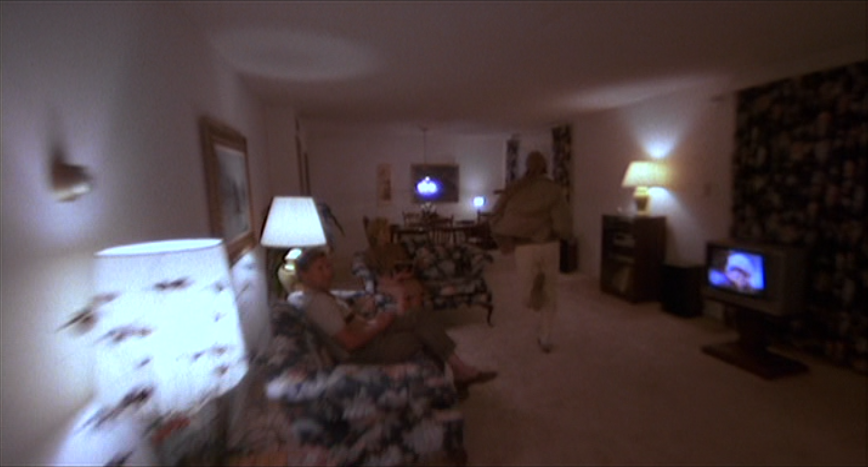
The chase also includes an exhilarating run through a multi-story pre-fabricated suburban home. H.I. bursts through the front door and runs rampant through bedrooms, dens, and living rooms. The occupants of the household, who are only glimpsed for mere moments, never once overtly react to the pursuit taking place in their abode. The father sits on the couch across from the television and just casually looks up. The great thing about these moments is that the Coens are smart enough not to draw attention to these peripheral asides. They exist on the edges of the frame, never once is there a close up or reaction shot from the family.
This chase is the scene most often referred to when discussing Raising Arizona and it admittedly is a bravura, high-concept high wire act. But there is another action scene in the film that equals the grocery chase in terms of filmmaking and narrative construction. This scene is the finale which sees H.I. and Ed trying to take the baby Nathan, Jr. back from the clutches of The Lone Biker of the Apocalypse. The Coens pull out all of the stops here with an action scene that probably cost more to film than all of Blood Simple combined. The Lone Biker of the Apocalypse appears in a mushroom cloud explosion on the horizon and proceeds to ride into the frame, shooting out both the front and rear windows of the couple's car. He then rides by and throws a grenade inside. The Coens then show both characters fleeing for their lives.
The heart of the film is Ed, particularly the hurt and longing exhibited by the great Holly Hunter. After escaping the now obliterated vehicle she grabs Nathan, Jr. and runs into a bank for safety, a mom protecting her kin, even if she stole the child in the first place. H.I. then gets into a brutal bout of fisticuffs with The Lone Biker of the Apocalypse which also ends in an explosion, with H.I. literally destroying the demons that have plagued him since the kidnapping. From here on out, this career convict will do the right thing and we believe it.
05 September 2013
Coen Countdown: Blood Simple.
It has been three long years since the Coen brothers have released a motion picture, a gap of inactivity as long as any in their thirty year career. Thankfully that will all end this December with the arrival of their sixteenth feature, Inside Llewyn Davis. Inspired by a recent conversation on Letterboxd, I have decided to spend the fall working my way chronologically through all of the Coens' feature films and maybe writing something up here on the old soapbox if the mood strikes me.
A man discovers his wife is having an affair so he hires a thug to bump them off. However, the thug has other plans, so he kills the husband instead, takes the money, and runs.
Over the course of their three decade career, the Coen brothers have often dabbled in the genre forms of classical Hollywood, from the screwball comedy of The Hudsucker Proxy to the gangster world of Miller's Crossing. The brothers' debut feature Blood Simple is most often described as a neo-noir and the film certainly shares elements with the shady crime films of the 1940s and 50s, as well as with the genre's forebearers, pulp novels. (Blood Simple's title in fact is taken directly from the work of author Dashiell Hammett.) But the film actually plays out more like a horror movie than anything else and is the Coens' most sustained work within that environment. Half a decade later, their film Barton Fink takes a sharp left turn into horror as its protagonist begins his journey into a literalized hell, but Blood Simple, with its low budget aesthetic and pulse-pounding tension, lives more fully within the genre.
The horror elements in Blood Simple range from a brief nod to early Coen-collaborator Sam Raimi's Evil Dead tracking shot to the excrutiatingly tense finale, which sees a relentless monster first killing John Getz's Ray and then terrorizing the adulterous Abby, played wonderfully by Frances McDormand. Of course, being the Coens the murderous villain is not a boogeyman like the masked Michael Myers or an unstoppable killing machine like Arnold Schwarzenegger's Terminator. Instead it is the bloated, sweaty body of M. Emmet Walsh as a slimy private investigator named Loren. No bother, the fear is equally palpable.
Also scattered throughout the picture are jolts of unexpected action, akin to a creature jumping out of the shadows and screaming "boo!". In Blood Simple however, it is the innocuous elements of day-to-day existence that come screaming into the frame, pulling the characters (and us) out of our own reveries and back to cold, cruel reality. Twice in the film this alarm comes from the ubiquitous telephone, first as a latent dialtone and later as a jarring, shrill ring. But the biggest jolt in the film's ninety minutes comes when Ray and Abby are standing at Ray's front door, both confused and frightened, when out of the blue a newspaper comes sailing into the frame, slamming against the screen and providing more thrills than a thousand makeshift ghosts.
The film obsessively forces our attention towards mundane objects like telephones and newspapers. A handful of scenes begin with shots of lazily turning ceiling fans, staring down upon the action like bored gods. In fact, a ceiling fan is the only witness to Loren's shooting of Abby's husband Marty. Meanwhile the last shot of the movie is Loren's point of view as he ponders the oddness of a dripping pipe on his way to gunshot-inflicted oblivion. The Coens also populate their film with very specific objects that highlight their famed attention to detail. Be it the glass of Alka Seltzer that inadvertantly tells us all we need to know about Marty's character, to the Zippo lighter inscribed with Loren's name and the words "Man of the Year" that nod to the character's opening monologue, the Coens know exactly what they want and more importantly, what we need.
If we were to boil down the overarching theme of the Coens oeuvre into a single, simplified maxim it could very well be a preoccupation with idiots getting in over their heads. While that description could sum up nearly all of their films, nowhere is it better exemplified than in Blood Simple. At no point in the film does any character have a complete grasp on what has transpired. The lovesick Ray thinks that Abby shot Marty when in fact it was Loren. The film concludes with Abby running from Loren, all the while thinking he is Marty, who is long since dead. She even shoots him under the impression that he is her vengeful husband. This makes a dying Loren laugh. It made me laugh too.
One sign of truly great artists comes from revisiting their earliest work and discovering that all of the elements that make them worthwhile were there on display from the very beginning. This is readily apparent throughout Blood Simple. It extends from the brothers' recurring themes to their nuanced dialogue in this singular screenplay as well as to their visual wit and elegantly framed compositions. If there is any mission statement in Blood Simple, something that signals the Coen brothers' arrival in cinema, it may very well be the tracking shot that runs the length of Marty's bar and takes the time to climb over the drunk passed out in the middle of it. Or perhaps it's the face of the kind stranger that informs Ray, the man who earlier laughed at Marty as the latter got caught on a dead end street, that his headlights are still on.
01 January 2013
My Top Ten Most Anticipated Films of 2013
Welcome to the most optimistic post of the year! It's all a spiraling ball of negativity from here on out. Below are the ten films scheduled for release sometime in the next 364 days that have me standing outside at midnight in the theatre of my mind. There is a new rule being implemented this year so please pay close attention. If a film I mentioned in a previous year's list is finally making its way into theatres after any number of delays, it can't make the cut, as I hate repeating myself. Sorry The Grandmaster and To the Wonder. Without further ado, here are your ten 2014 Best Picture Oscar nominees!
10. Upstream Color
There are a few distinct camps centered around Shane Carruth's directorial debut, the mega-low-budget time-travel feature Primer. There are those who find it an impenetrable mess, those that understand it completely (I call this camp "the liars") and those that were puzzled, fascinated and invigorated by it. Count me in as a card-carrying member of Group C. Excepting some work on Rian Johnson's Looper, Upstream Color will be Carruth's first film work in nearly a decade. The film is a love story featuring two people living in an ageless organism. Seeing the film probably won't make it any clearer.
9. Frozen
I may not be obligated to see every single animated Disney film from now on but the CGI Frozen sounds promising enough. Based on the fairy tale The Snow Queen, the film stars Kristen Bell as Anna, an estranged princess who must trek across icy tundra to vanquish the wicked queen. Let's hope that this role is a winner for Bell who hasn't been able to parlay her idiosyncratic talents into anything worthwhile since Veronica Mars. The production art for the film teases a crisp, unforgiving environment and Disney has done all right by itself when adapting the works of Hans Christian Andersen in the past.
8. Queen of the Desert
Werner Herzog and Naomi Watts. Naomi Watts and Werner Herzog. Queen of the Desert is the story of the explorer Gertrude Bell, British attaché in the early 1900s. It is Herzog's first fictional film since Nicolas Cage talked to imaginary iguanas and by all accounts seems like a far more austere affair. (However, don't entirely dismiss the potential for some crazy camel shenanigans.) Sure, detractors will point out that Robert Pattinson is attempting to fill the shoes of Peter O'Toole by playing T.E. Lawrence, and Jude Law is also running around here somewhere, but just remember: Werner Herzog and Naomi Watts.
7. Her
The restlessly inventive Spike Jonze returns to the big screen with this story of a man, played by Joaquin Phoenix, who falls in love with his computer's new operating system. While the premise sounds like the work of frequent Jonze collaborator Charlie Kaufman, this go-around it is borne solely from Jonze's mind. Spike has yet to top the achievement of Being John Malkovich, his feature film debut, but both of his films since then have shown potential and contain several glimpses of the genius more frequently found in his short film work. Samantha Morton, Rooney Mara and Phoenix's co-star in The Master, Amy Adams, also appear.
6. Inside Llewyn Davis
Following their Oscar-winning return with 2007's No Country for Old Men, the Coen brothers went into a steady rhythm of releasing a film per year. But since 2010's enjoyable but rather thin remake of True Grit, the brothers have been silent. Come February that will change with their tale of a Greenwich Village folk singer in the early 1960s. The film is loosely based on the memoirs of Dave Van Ronk and should provide the brothers with a cast of characters crazy enough to rival The Big Lebowski and a soundtrack that might match O Brother, Where Art Thou's ubiquity.
5. Star Trek Into Darkness
Step aside Christopher Nolan and Michael Bay, J.J. Abrams is the real blockbuster auteur of our time. His last two features, Super 8 and the Star Trek reboot, were the best films of their respective summers. Now that he got the pesky introductions out of the way and created that genius parallel timeline so that the new films can go and do whatever the hell they damn well please, the real fun should begin with this Star Trek sequel. How could it not, when the villain is played by Sherlock's own Benedict Cumberbatch? Let's hope this film has more of Simon Pegg's Scotty. Bring on the lens flares.
4. The World's End
Speaking of Simon Pegg, he has finally reunited with his Spaced companions Edgar Wright and Nick Frost to complete the third and final installment of their epic Cornetto trilogy, after Shaun of the Dead and Hot Fuzz. Pegg and Frost play friends who come together in their forties to recreate a pub crawl they completed twenty years ago. Meanwhile, the Earth decides to bring about Armageddon. It is going to be quite a task reaching the heights of wit and hilarity of their first two collaborations but The World's End sounds just epic enough to achieve it.
3. Only Lovers Left Alive
My favorite film of 2009 was Jim Jarmusch's little seen and little loved, The Limits of Control, a glorious synthesis of themes the auteur had been pondering for roughly a decade. The Limits of Control can be seen as a cinematic culmination, a film that wipes the slate clean and leaves the director with a bold, white canvas with which to work with. His new film appears to take that freedom and run with it full throttle. Tilda Swinton and Tom Hiddleston play centuries-old vampires who reunite when Hiddleston, now a musician, becomes depressed by mankind's direction. Who's a what now?
2. The Wind is Rising
Chances are Hayao Miyazaki's new film won't reach American shores before the end of the year but I don't care, I'm throwing it on here anyway. Maybe I'll just hop on over to Tokyo one weekend and catch this. That'll show you. This new animated feature is about the life of Jiro Horikoshi, celebrated designer of World War II fighter planes. The film continues Miyazaki's obsession with flight and rumor has it some of the pilots are anthropomorhized pigs, like the star of Porco Rosso. Expect some exquisitely designed backgrounds, flawless and kinetic action scenes, and some crazy magical stuff you can't wrap your head around.
1. The Tale of Princess Kaguya
Speaking of Studio Ghibli, exactly twenty-five years ago the famed animation company released Miyazaki's masterpiece My Neighbor Totoro on the very same day as studio co-founder Isao Takahata's heartbreaking tale of two brothers struggling to survive in the ruins of World War II, the phenomenal Grave of the Fireflies. To commemorate the greatest day in Japanese cinema history, the studio will be releasing Takahata's new film about a princess borne of bamboo the same day as The Wind is Rising. How can the world be so awesome?
10. Upstream Color
There are a few distinct camps centered around Shane Carruth's directorial debut, the mega-low-budget time-travel feature Primer. There are those who find it an impenetrable mess, those that understand it completely (I call this camp "the liars") and those that were puzzled, fascinated and invigorated by it. Count me in as a card-carrying member of Group C. Excepting some work on Rian Johnson's Looper, Upstream Color will be Carruth's first film work in nearly a decade. The film is a love story featuring two people living in an ageless organism. Seeing the film probably won't make it any clearer.
9. Frozen
I may not be obligated to see every single animated Disney film from now on but the CGI Frozen sounds promising enough. Based on the fairy tale The Snow Queen, the film stars Kristen Bell as Anna, an estranged princess who must trek across icy tundra to vanquish the wicked queen. Let's hope that this role is a winner for Bell who hasn't been able to parlay her idiosyncratic talents into anything worthwhile since Veronica Mars. The production art for the film teases a crisp, unforgiving environment and Disney has done all right by itself when adapting the works of Hans Christian Andersen in the past.
8. Queen of the Desert
Werner Herzog and Naomi Watts. Naomi Watts and Werner Herzog. Queen of the Desert is the story of the explorer Gertrude Bell, British attaché in the early 1900s. It is Herzog's first fictional film since Nicolas Cage talked to imaginary iguanas and by all accounts seems like a far more austere affair. (However, don't entirely dismiss the potential for some crazy camel shenanigans.) Sure, detractors will point out that Robert Pattinson is attempting to fill the shoes of Peter O'Toole by playing T.E. Lawrence, and Jude Law is also running around here somewhere, but just remember: Werner Herzog and Naomi Watts.
The restlessly inventive Spike Jonze returns to the big screen with this story of a man, played by Joaquin Phoenix, who falls in love with his computer's new operating system. While the premise sounds like the work of frequent Jonze collaborator Charlie Kaufman, this go-around it is borne solely from Jonze's mind. Spike has yet to top the achievement of Being John Malkovich, his feature film debut, but both of his films since then have shown potential and contain several glimpses of the genius more frequently found in his short film work. Samantha Morton, Rooney Mara and Phoenix's co-star in The Master, Amy Adams, also appear.
Following their Oscar-winning return with 2007's No Country for Old Men, the Coen brothers went into a steady rhythm of releasing a film per year. But since 2010's enjoyable but rather thin remake of True Grit, the brothers have been silent. Come February that will change with their tale of a Greenwich Village folk singer in the early 1960s. The film is loosely based on the memoirs of Dave Van Ronk and should provide the brothers with a cast of characters crazy enough to rival The Big Lebowski and a soundtrack that might match O Brother, Where Art Thou's ubiquity.
5. Star Trek Into Darkness
Step aside Christopher Nolan and Michael Bay, J.J. Abrams is the real blockbuster auteur of our time. His last two features, Super 8 and the Star Trek reboot, were the best films of their respective summers. Now that he got the pesky introductions out of the way and created that genius parallel timeline so that the new films can go and do whatever the hell they damn well please, the real fun should begin with this Star Trek sequel. How could it not, when the villain is played by Sherlock's own Benedict Cumberbatch? Let's hope this film has more of Simon Pegg's Scotty. Bring on the lens flares.
4. The World's End
Speaking of Simon Pegg, he has finally reunited with his Spaced companions Edgar Wright and Nick Frost to complete the third and final installment of their epic Cornetto trilogy, after Shaun of the Dead and Hot Fuzz. Pegg and Frost play friends who come together in their forties to recreate a pub crawl they completed twenty years ago. Meanwhile, the Earth decides to bring about Armageddon. It is going to be quite a task reaching the heights of wit and hilarity of their first two collaborations but The World's End sounds just epic enough to achieve it.
3. Only Lovers Left Alive
My favorite film of 2009 was Jim Jarmusch's little seen and little loved, The Limits of Control, a glorious synthesis of themes the auteur had been pondering for roughly a decade. The Limits of Control can be seen as a cinematic culmination, a film that wipes the slate clean and leaves the director with a bold, white canvas with which to work with. His new film appears to take that freedom and run with it full throttle. Tilda Swinton and Tom Hiddleston play centuries-old vampires who reunite when Hiddleston, now a musician, becomes depressed by mankind's direction. Who's a what now?
2. The Wind is Rising
Chances are Hayao Miyazaki's new film won't reach American shores before the end of the year but I don't care, I'm throwing it on here anyway. Maybe I'll just hop on over to Tokyo one weekend and catch this. That'll show you. This new animated feature is about the life of Jiro Horikoshi, celebrated designer of World War II fighter planes. The film continues Miyazaki's obsession with flight and rumor has it some of the pilots are anthropomorhized pigs, like the star of Porco Rosso. Expect some exquisitely designed backgrounds, flawless and kinetic action scenes, and some crazy magical stuff you can't wrap your head around.
1. The Tale of Princess Kaguya
Speaking of Studio Ghibli, exactly twenty-five years ago the famed animation company released Miyazaki's masterpiece My Neighbor Totoro on the very same day as studio co-founder Isao Takahata's heartbreaking tale of two brothers struggling to survive in the ruins of World War II, the phenomenal Grave of the Fireflies. To commemorate the greatest day in Japanese cinema history, the studio will be releasing Takahata's new film about a princess borne of bamboo the same day as The Wind is Rising. How can the world be so awesome?
Labels:
2013 films,
coen bros,
disney,
edgar wright,
her,
herzog,
inside llewyn davis,
j.j. abrams,
jarmusch,
miyazaki,
only lovers left alive,
queen of the desert,
spike jonze,
star trek into darkness,
the world's end
Subscribe to:
Posts (Atom)