15 May 2012

Disney Daze: Week 18: The Sword in the Stone

In 2012, this intrepid reporter plans to watch, in chronological order, all of Walt Disney Studios' 52 theatrically-released animated features, one per week.


The Disney studios were no stranger to tales involving royalty, castles, and magic. Their bread and butter had come largely from films such as Cinderella and Snow White and the Seven Dwarfs, stories that featured idealized glimpses of nobility and regal bearing. The happily-ever-afters of these films involved a debonair prince and a fortress of solid stone. And yet the studio had only shown the romantic side of these legends. What of the men of these pictures? What was their story, where did they come from? Was there more to be said than was initially perceived by these ciphers of indeterminate qualities? 1963's The Sword in the Stone provides one possible answer, although the story is far from dashing. 


The film is based on T. H. White's Arthurian legends, collected in the series The Once and Future King. Animator, writer, and children's author Bill Peet adapted the story into a series of episodic events that mainly shows the wise yet clumsy wizard Merlin teaching his ward "Wart" (or Arthur) - a lackey longing to be a squire - lessons by turning him into various creatures. First he's a fish, then he's a squirrel, and finally he has become a sparrow. Some oblique lessons are gleaned from these experiences, all after fleeting brushes with death. Merlin's confidante and companion is a talking owl named Archimedes who also spends time teaching Arthur but prefers books to experience. (It is rather interesting that the human tutor chooses instruction through mimicking an animal, while the animal touts scholarly study.) 


Due to a lack of narrative drive, the picture drags in places and ultimately feels tedious and repetitive. However there are some nice moments sprinkled throughout. When Arthur is slumming as a squirrel, he runs into a female member of the species who instantly becomes twitterpated. She fawns over Arthur, following him around to his general annoyance and ultimately saves him from the clutches of a Wile E. Coyote-esque wolf who has been hunting Arthur (no matter his genus) throughout the picture. After she rescues Arthur, the female squirrel clings close to her beloved, who unfortunately is all too quickly turned back into a human. He then leaves her to return to civilization. The squirrel is crushed and her emotions hit hard as she gazes longingly into the distance as dusk descends.


The animal transformations reach their zenith after the sparrow Arthur is captured by Merlin's rival the hideous witch, Madam Mim. Merlin arrives at the last moment to save Arthur and challenges Mim to a duel, where the two magicians try to destroy one another by becoming various creatures. The scene is decently conceived and it is nice to see the unexpected choices that Merlin makes (mouse, crab, goat, germ) but by this point in the picture the transformations have become all too routine and there is no source of real drama to the proceedings. Mim is quickly vanquished and Merlin and Arthur once again return to the castle. Shortly thereafter Arthur pulls the sword from the stone - a plot point not mentioned since the film's introduction - is crowned king, and the credits roll.


The Sword in the Stone is the first Disney animated feature to contain musical compositions by the heralded Sherman brothers, Richard and Robert. Heretofore the brothers had contributed songs to several of the live-action Disney features of the early sixties, including The Parent Trap and The Absent-Minded Professor. Unfortunately their work on The Sword in the Stone is for the most part bland and forgettable, a shocking summation when one looks at their subsequent body of work, which would include the award-winning soundtrack for Mary Poppins, as well as several iconic Disneyland attractions, including the Enchanted Tiki Room and it's a small world. Their compositions in Stone are limited to a clunky attempt at turning the opening fairy tale narration into song, and a blatant knock-off of Cinderella's "Bibbidi-Bobbidi-Boo" (the far less enchanting "Higitus Figitus".) 


Like the soundtrack, mediocrity rules the day in The Sword in the Stone. It was the first film where the layoffs in the animation department, along with a meager budget, are overwhelmingly apparent. One Hundred and One Dalmatians managed to achieve some sort of notable artistic style, using its xerography method to an occasional advantage. Here the animation looks too rough, with pencil strokes bleeding out of character designs that are staged against flat, static, and often monochromatic backgrounds. A series of blank canvasses for uninspired animation. The look of the film is not quite ugly - but it is far from beautiful. In fact, embracing ugliness would have made for a more interesting visual experience, instead all we get is serviceable and dull.


06 May 2012

Disney Daze: Week 17: One Hundred and One Dalmatians

In 2012, this intrepid reporter plans to watch, in chronological order, all of Walt Disney Studios' 52 theatrically-released animated features, one per week (except when he falls behind because he was at Disneyland).


Despite the debt the studio incurred after the lavish Sleeping Beauty failed at the box office, Walt Disney vowed to keep the animation department open even though it had become one of the least profitable divisions of his ever-expanding company. The man who constantly reminded everyone that it all started with a mouse, knew all too well that Disney was synonymous with animation and while the studio expanded to live action features, television, and theme parks, they needed to retain their core identity. Unfortunately retaining the animation division was different than maintaining the animation division, and post-Sleeping Beauty saw the largest downsizing in the company's history. The animated features from here on out would have to be made quickly and inexpensively. Half decades could not be spent tinkering on stories or toying with new processes.


Interestingly enough a new process called xerography is what enabled all of this change to come about. Developed by the largely unsung Ub Iwerks, who co-created Mickey Mouse with Walt and drew almost the entirety of the early shorts himself, xerography was a process that allowed the animators' original drawings to be photocopied, or Xeroxed, directly onto animation cels. This negated the need for a department to ink the sketches to cels, therefore cutting labor costs significantly. The process resulted in a whole new look for Disney films, where looser designs prevailed, as the animators' style made it onscreen intact. Walt himself did not like the sketchy new look but by this time his involvement with animation was nominal and he understood the economic necessity of such a timesaver. In particular, the studio's first feature to be produced with xerography, would benefit greatly from the process as it required the design of a hundred spotted dogs.  


The title sequence in One Hundred and One Dalmatians is both my favorite of all the Disney features as well as the best section of the whole film. It begins with a splash of spots being sprayed on myriad hand drawn hounds.  With a hip, jazzy flourish, the title briefly appears only to be washed away with yet more spots. Other credits are shaved offscreen like fur. Some title cards become both an extension of the dog theme and a whimsical translation of the title being displayed. For example, a series of spots transform themselves into moving musical notes to herald the work of George Bruns, the orchestration of Franklin Marks, and songs of Mel Leven. The layout artists' page is literally laid out before us. The sequence takes up a full three minutes and is worth every frame.


Of course, praising the credit sequence as the best moment in any film is nothing if not a backhanded compliment. Luckily One Hundred and One Dalmatians has more going for it than just the title design. The introductions of the main players in the film, the dogs Pongo and Perdita and their "pets" Roger and Anita, are charming. We pan across a beautifully designed London landscape before zooming into Roger's cluttered apartment. He is toiling away at the piano while Pongo looks out the window searching for a mate for his guardian. Here we get a lovely sequence of prospective brides, all parading down the boulevard with their dogs, each an identical caricature of their guardian. The joke is rather obvious but the execution is well done. 


Soon Pongo espies Perdita and Anita heading for the park and he tricks Roger into taking him for a walk. The meet-cute of these two couple is another solid piece of animation, with great set-ups and a pleasing pay-off as Pongo causes all manner of disturbance to get his dreamer of a guardian to notice the comely woman reading on a park bench. As these things usually go, this ultimately involves dunking them both in a lake. The best part of this scene is the animators' work on Pongo's facial expressions as he sees his plan coming together. His tongue out, open-mouthed joy is particularly infectious.


From here we flash forward to domestic life as the two couples, both canine and human, now reside under the same roof. Perdita is pregnant and this news warrants a visit from the devious, ghoulish villain Cruella de Vil, who gets a phenomenal introduction as Roger composes a jazzy song detailing her devilish traits. The musical sequence is perfectly animated, showing Cruella's silhouette approaching the front door as Roger calls her "a spider waiting for the kill" and suddenly the window frame looks just like a web with Cruella standing in the center. She then barges in and gives the audience a tour-de-force in villainy. Cruella de Vil is vile, vicious, and vain. While most animation on One Hundred and One Dalmatians was collaborative, with several animators sharing characters, the great Marc Davis, one of Disney's heralded Nine Old Men, was solely in charge of Cruella. And what a hell of a job he did. Dalmations would be Davis's swan song in animation as Walt moved him over to Disneyland where he left his indelible mark on the designs of such attractions as Pirates of the Caribbean and the Haunted Mansion. Cruella in fact looks eerily like a distant cousin of the latter attraction's infamous Hatbox Ghost.


Shortly hereafter Perdita has fifteen pups who are subsequently stolen by Cruella's dimwitted henchmen and taken to a run down mansion in the English countryside where they will be kept along with dozens more dalmatians until they're fully grown and slaughtered for their fur. Charming. Regrettably just as the plot kicks in, the film for the most part loses itself. There are a number of factors for the film's failings. There is very little effort on the directors' or animators' part to distinguish between any of the puppies, besides the fat one who is always hungry. This gives us nothing tangible to latch onto in moments of danger. Of course, the thought of a puppy perishing should be reason enough for dramatic tension but it simply doesn't work in practice with so many interchangeable dogs running around. On Snow White we spend ample time with the seven dwarfs, and while their personalities are basically the descriptions inherent in their names, we become attached to them. Another problem with the film's latter half is pacing. There is only a short amount of screen time spent getting the dognapped puppies to the mansion and for Pongo and Perdita to travel through the country to retrieve them. However the journey back takes twice as long and becomes nothing more than tedious since we are never given an idea of how much ground has been traveled nor how much is left to go. Therefore it becomes quite a shock when the animals return home and we discover that they've been gone over a month. Onscreen it plays out like two long days and nights. 


One Hundred and One Dalmatians has a few special treats but fails to live up to the best in Disney animation. Some of the best moments are the most fleeting. Twice in the film we get glimpses of television programming that are deliriously surreal. The first program is watched by the puppies at home and is a typical 1950s-style western with a dog in the hero's role. The interesting moment comes with the commercial that follows. The product advertised is a snack called Kanine Krunchies and features a whacked-out, warped jingle with sparse line drawn animation. Why was screen time given to a dozen dogs watching a black-and-white television? Is this some sort of social commentary? Later in the film at Cruella's decrepit mansion, the thugs Jaspar and Horace are transfixed watching their favorite game show "What's My Crime?" wherein criminals are trotted out before well-to-do contestants who try and guess their infractions. It is moments like these that stick out with One Hundred and One Dalmatians, when a little bit of personality and casual weirdness peek out from the spotted blur.

04 May 2012

Dropping Science Like Galileo Dropped the Orange: Personal Reflections on the Beastie Boys in Honor of Adam Yauch


To me, the Beastie Boys will always be the coolest band of all time. From their arrival as farcical frat boys on their drunken debut album Licensed to Ill, to the mash-up madness of their masterpiece Paul's Boutique, and the subsequent stylistic reinventions found on albums like Check Your Head and Ill Communication, the Beastie Boys were always one step ahead of the rest of us. Even when they stopped caring about being cool, around the time they appeared stuffed inside a sardine can on the cover of 1998's Hello Nasty, they became cooler for not being cool. Or something like that. And last year's triumphant return with the phenomenal Hot Sauce Committee Part II confirmed that whether they were busy playing pranks, punk rock, or basketball; whether they were fighting for human and/or party rights, or just sticking their dicks in the mashed potatoes; the Beastie Boys were always the coolest guys around. With the death of Adam Yauch today from cancer at the young age of 47, the world lost a major part of its awesomeness.


I always thought that Adam Yauch, whose nom de Beastie was MCA, would have made a fascinating subject for a well-researched biography or in-depth documentary. Yauch was the member of the group that went on the most transformative of personal journeys over his quarter century in the spotlight. Mike D has and always will be the goofball, while Ad-Rock was both the pin-up prankster as well as the most gifted musician, but Yauch started out as the aggressive one, a young man who was angry and confused, who took drugs and carried guns, only to find himself later in life won over by Buddhism, a lifestyle which saw him blossom into a peaceful, loving vegan. Through the years he would come to take on the roles of activist, filmmaker, and producer, all while continuing to push his music into wonderful new territories.


Obituaries will abound in the next several days and my goal is not to sum up a life but to show how much impact it had on one. I've known the Beastie Boys' music since before I was cognizant. Thanks to my older brother Shawn (who indoctrinated my toddler self into Star Wars as well) I was practically born into the Beastie Boys. One of my earliest memories comes from when I was five or six and living in Fresno, California. I remember lying on Shawn's bed with his big grey boom box nearby, cranking Licensed to Ill and... taking a nap. Ah the soothing lullaby of "No Sleep Til Brooklyn".


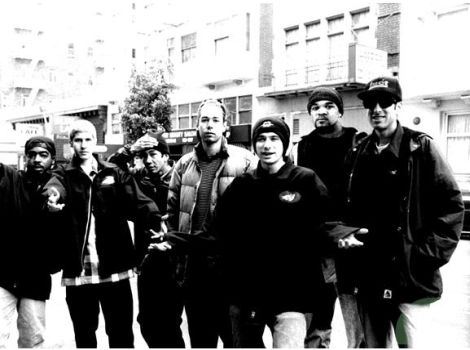
Also around this time I remember seeing an article in the Fresno Bee about the Beastie Boys coming to town on their worldwide Licensed to Ill tour. I don't know if Shawn made it to that show or not, nor do I remember anything pertinent in the article since I could barely read, but I remember the picture of the Beastie Boys so well. They were standing on a street corner that later in life I realized must have been some grimy spot in Brooklyn, but at the time I thought was taken right there in Fresno. How else could it have made it into the Bee? Who knows how accurate these memories are a quarter century removed from their occurrence. All I know is that I've carried them around all my life. For some reason they stuck.


A decade or so later, when I was first becoming interested in music myself, as opposed to aping the tastes of my hip older brother, I got hooked on the Beasties' 1994 album Ill Communication which spawned the massive hit "Sabotage" and subsequently the greatest video of all time. My first day of high school happened to fall on my 13th birthday and I wore my brand new Ill Communication ringer tee-shirt to commemorate. My father proudly took a photo of me wearing the shirt before I left for school that morning. I wonder where that photo is now...


My friend Mike Braida owned the VHS copies of the Beastie home videos, Skills to Pay the Bills and Sabotage (as well as a kick ass ABA/Aloha Mr. Hand shirt he got at Tower Records). We were really into skateboarding at the time and I remember freeze-framing the skate footage the Beasties edited in all afternoon long. I was really into hardcore too, mostly early Black Flag and Minor Threat, and I would play the hell out of songs like "Heart Attack Man" on my Walkman while skating the 7-11. To me, one of the greatest Beastie Boy records is the one-off Aglio e Olio EP which was released prior to Hello Nasty. It's eight punk rock songs in eleven minutes. My younger brother Christopher, who probably loves the Beasties most of all, hated it. He sold it to me for a $1.


I've always said that my mother, who passed away from cancer ten years ago this summer, heard Licensed to Ill more than anyone in our family because she had three sons who all went through their own personal Beastie Boys phases. I bet she could've completed the "Paul Revere" couplets my brothers and I whiled away car trips reciting. Once she and I were driving around our suburb of a suburb in her silver Subaru Loyale, listening to the Beasties, and she came to the realization that the Beastie Boys' style is basically that of nursery rhymes. She was very excited by this revelation and subsequently told my older brother. He was skeptical.


In the summer of 1998, my mom took me and my friend Mike up to visit my aunt in Seattle. (While there we saw a film at the theatre I would end up working at six years later, which coincidentally also left us this week.) Hello Nasty had been released earlier in the month and every record store Mike and I went into, or bar we passed, or car that stopped, was bumping that album. The release of Beastie Boys albums were massive cultural moments. The whole world would eagerly anticipate the Boys' latest transmission and upon release would thoroughly comb through its beats and rhymes for new catchphrases, jokes, and insight. The world has now lost a piece of that unity and while I hope that Mike D and Ad-Rock continue to make music and art, the Beastie Boys are no more. They gave us all a towering collection of songs, slang, and style, and for some of us they gave even more. They were there throughout our lives, commenting on and reflecting our world back at us.


Farewell MCA. Thanks for everything.

20 April 2012

Disney Daze: Week 16: Sleeping Beauty

In 2012, this intrepid reporter plans to watch, in chronological order, all of Walt Disney Studios' 52 theatrically-released animated features, one per week.


Sleeping Beauty is a marvel of a picture. It possesses that intangible "magic" that made the first five Disney features so invigorating and unique. In that respect it could be looked upon as a return to form, as the studio once again put all of its money and might at the expense of one monolithic project. The hallmarks of these earlier triumphs show up time and again in Sleeping Beauty (the multi plane camera is back!) and yet the film also looks forward, expanding the filmmakers palette and providing audiences with new thrills and deeper dimensions.


Much of Sleeping Beauty's singularity can be contributed to one man, Eyvind Earle. Earle, an accomplished classical painter, was chosen to create the backgrounds of the film. He wanted the film to resemble tapestries and stained glass befitting the fairy tale's setting. While the films that preceded Sleeping Beauty had talented and original artists guiding the production style - Alice in Wonderland had Mary Blair's pastel whimsy, while Lady and the Tramp benefitted from Claude Coats's fanatical attention to detail - no person's vision made it to the screen more intact than that of Earle. This was by decree, as Walt, whose involvement with the film was minor, told the animators to do everything Earle's way. This caused more than a little consternation, as the lead animators thought that their drawings were getting lost in Earle's meticulously composed backgrounds. The thing is, they're right, but that is what makes Sleeping Beauty so exhilarating. There is a tension onscreen at times, particularly in scenes taking place at Stefan's castle, that provide a stimulating visual jolt. The widescreen process, presented here in Technirama, only manages to consume the characters even more. Every shot is framable, a deep tableaux of multiple perspectives and intricate design. 


It can be argued that the film is just another retread of the formula that Snow White and the Seven Dwarfs made so successful. Like Cinderella before it, Sleeping Beauty takes the basic elements of Disney's first feature as a template. Unlike that vastly inferior rehash, Sleeping Beauty manages to take the triumphs of Disney's first feature and make it its own. Here, like Snow White, a beautiful woman is destined to be princess but finds herself thwarted by a vain, nefarious individual. The princess hides in the forest and is taken care of by little, whimsical creatures. A dashing prince saves her from her fate and restores her to her rightful destiny.


While all of these Snow White comparisons are apt, I find them to be for the most part, entirely superficial. From a different perspective, the film that Sleeping Beauty reminds me of the most is Walt's experimental masterpiece, Fantasia. There are specific special effects that harken back to moments in Disney's third feature. For example, as the fairies bestow their gifts upon the infant Aurora, the screen is filled with a spinning magical nebula, using the same process that created the primordial galaxy at the beginning of Fantasia's "Rite of Spring" sequence. The jagged craggy castle of Maleficent bears striking resemblance to Bald Mountain and to drive the comparison home, the film cuts to the interior where her minions dance around a spooky green fire as if they were possessed by the demonic Chernabog. 


And of course, both Fantasia and Sleeping Beauty share an affinity for classical music. In fact they both share a composer. Tchaikovsky's "Nutcracker Suite" accompanied many of Fantasia's most beautiful images. Here the score he composed for the ballet of Sleeping Beauty is used in a novel fashion. Walt commissioned a series of songs to be built around Tchaikovsky's music. Bits were broken up and vocal lines were recorded atop the passages. The most prominent song in the film is "Once Upon a Dream" which uses a lilting melody to great effect. For my money though, the best use of music in the entire film does not involve lyrics. Late in the film, the score provides an insidious and creepy accompaniment to images of a possessed Aurora, who - led by Maleficent's green glow - walks through dark castle corridors toward the dreaded spindle. The music here is haunting and gorgeous, eerie and seductive.


What sets Sleeping Beauty apart from a lot of its fairy tale predecessors is that every character is well-rounded, or at least more fully defined than usual. For example, Prince Phillip is the first Disney prince to be given any opportunity to carve out a personality. He gets to meet-cute with Aurora, defy his father, become imprisoned at the hands of the scheming Maleficent, and ultimately destroy her by stabbing her in the heart and throwing her off a cliff. Speaking of Maleficent, she is by far the greatest of all Disney villains. Her cruelty and hatred knows no bounds. At one point in the picture she even proclaims herself "the Mistress of All Evil". It has been pointed out elsewhere that the only reason she curses a newborn baby to death is that she wasn't invited to a party. Now that's cold. Oh, and when Phillip finally vanquishes her with his sword? She's a goddamn fire-breathing dragon at the time. 


If anyone gets short shrift in the picture it is our titular star, Aurora/Briar Rose, who only gets one big scene to herself. This is her introduction where the three fairies send her off to pick berries and she pines away for her dream lover, ultimately dancing with a menagerie in Phillip's borrowed clothes. Other than that she has a brief falling out with the fairies and then becomes entranced and falls asleep. From my calculations she's only onscreen for about a fourth of the picture, and for part of that she is unconscious. In a way, this could be construed as nit-picking since one doesn't really notice as the film unfolds, and the elements that take her place are on the whole engaging and endearing. 


As with many of the studio's most enduring films, Sleeping Beauty was initially a failure. Critics and audiences were indifferent, if not dismissive of the film. The lavish production set the studio back some $6 million and it only turned a slight profit. Audiences of 1959 were flocking instead to Walt Disney's live-action family film The Shaggy Dog, which cost a fraction of Sleeping Beauty's production and went on to become the highest-grossing film in the studio's history. This disparity pushed Walt Disney ever further away from animation. His own personal attentions had been almost entirely consumed since the mid-1950s by his greatest achievement, Disneyland, and now he would be gone for good. Walt laid off several animators after Sleeping Beauty, turning the department back into a small unit, in a way returning the division to its original tight-knit workings. Except now the group had no charismatic, passionate leader who could instill the artists with purpose. That man had moved on.


13 April 2012

Disney Daze: Week 15: Lady and the Tramp

In 2012, this intrepid reporter plans to watch, in chronological order, all of Walt Disney Studios' 52 theatrically-released animated features, one per week.


Lady and the Tramp is unique among the first dozen Disney features as it was the only full-length story whose origin actually began at the studios. In the late 1930s, Dumbo co-writer Joe Grant approached Walt with an idea based on his dog, Lady, who he felt was neglected after Grant and his wife had had their first child. Walt liked the idea and gave Grant permission to develop the idea further. Unfortunately, the story never seemed to click. A few years later Walt read a short story in Cosmopolitan magazine that involved a sardonic dog he thought would be a perfect contrast to Lady's more refined ways. The studio bought the rights to the story and incorporated this new character into Grant's drafts. Once official production on the film was begun, Walt then commissioned the short story's author, Ward Greene, to write a novelization of the story the studio had created.


The resulting film is a crackerjack piece of entertainment that hits all of the right notes. Lady and the Tramp begins with a beautifully conceived scene of the recently-gifted puppy Lady tenaciously fighting to sleep in bed with the humans of her new household. The sequence plays out wonderfully as we see the dog whine, cajole, and con her way upstairs and into bed. The final shot of the puppy tucked in and sleeping transitions seamlessly to a morning six months later with a fully grown Lady waking up on the same spot of the bed. What follows furthers the phenomenal ability of the story and animation department as Lady bounds downstairs to meet the day. We are treated to a perfect simulacrum of a dog's perspective, the joys of burying a bone, the indignity of pigeons, and the duty of delivering a newspaper.


While there is some stiff rotoscoping apparent in the movement of some of the human co-stars, the animation in Lady and the Tramp is on the whole, sumptuous. The design and actions of the animals may not be quite as naturalistic as the beauty of Bambi - whose incomparable achievements are becoming increasingly apparent - but it is stellar work nonetheless. Lady and the Tramp easily contains the greatest animation in a Disney feature since that aforementioned masterpiece. The animators here capture the real essence of these creatures, most notably the canine stars who scratch and wag with deft realism. The film also boasts some truly lavish background work, depicting a turn-of-the-century town replete with tree-lined lanes and lush Victorian houses. Part of this lushness comes from Disney's decision to switch from a standard 1.33 aspect ratio, which was used on all preceding features, to the newer CinemaScope frame size. The artists needed to fill in the extra space on the edges and more attention was placed on fleshing out the backgrounds.


The film boasts an international cast of occasionally politically incorrect caricatures. There are the obvious accents and mannerisms affixed to the different breeds of dogs (the Scottish Terrier Jock speaks with a heavy brogue) as well as the exaggerated ethnic stereotypes of Italian restauranteur Tony, but no characterization comes close to being as offensive as that of the visiting Aunt Sarah's two Siamese cats, who terrorize Lady as they sing their insidiously catchy theme. While the lyric is forgettable at best and distasteful at worst ("when we finding baby, there are milk nearby") by far the best part of "The Siamese Cat Song" is the backing music, which consists of a repetitive plinking punctuated with gongs and thumps. The music sounds vaguely contemporary, like a Casio loop the RZA would use on a deep Wu-Tang Clan cut.


Luckily many of the characters in the film come through looking better than the cats. The best secondary character is the busy beaver who unwittingly frees Lady from the muzzle the hapless Aunt Sarah affixes upon her. The beaver makes a grand comedic entrance, measuring out sections of a recently felled tree. His professionalism and obsession with his damming task provide endless founts of levity. The mutt Tramp convinces the beaver to chomp down on the muzzle's strap by selling him on the idea that the restraint is a tool to help move logs more quickly. The scene is perfectly paced, leading up to the log rolling ever faster downhill, taking the beaver with it before they both go crashing into the river.


Lady and the Tramp is chock full of wonderfully constructed scenes like this. The beaver's spotlight is the film's great comedic moment, while the iconic spaghetti dinner provided by the singing Italians is a master class in romance. It is interesting to think that out of all the Disney features - many of which star princesses redeemed by true love - the greatest romantic moment is of two dogs eating leftovers in an alley. Later on in the film, Lady and the Tramp goes for the jugular when we are introduced to all of the unwanted dogs locked up at the pound.  They howl a mournful song as we see face after face of destitute pooches, their eyes filled with tears. It's sentimental, maudlin and manipulative, but it is also the Disney studio at the zenith of its storytelling powers.  


Lady and the Tramp is more than a little like its two titular protagonists, equal parts elegant and electrifying. It is a relentlessly crowd-pleasing romantic adventure told with unparalleled confidence and grace. The film's legacy can still be felt generations after its release. Pixar stalwart Andrew Stanton, director of such contemporary animated classics as Finding Nemo and WALL*E, recently appeared on the Filmspotting podcast where he sung the praises of Lady and the Tramp. It's hard not to see the effect the film had on Stanton. Beyond the simple marvel that is the film's economic storytelling; the fish tank Nemo calls a surrogate home feels like a stand-in for Lady and the Tramp's pound, while the opening montage of Lady running happily and wordlessly through the yard echoes WALL*E's daily routine on an abandoned planet. I can think of many a fate worse than being in WALL*E's position, wandering through a desolate wasteland with an old dubbed tape of Lady and the Tramp as my only companion.

06 April 2012

Disney Daze: Week 14: Peter Pan

In 2012, this intrepid reporter plans to watch, in chronological order, all of Walt Disney Studios' 52 theatrically-released animated features, one per week.


By the time the studio had begun work on Peter Pan, Walt Disney and his crew were settling in to a pleasant groove. At this point they had a solid template for producing features, they knew the beats required to successfully pull a story off. For the most part, the films that would be released in the last decade of Walt's life would fit neatly together as works of a kind. Quality would be relatively consistent, as would expectations. The films feature all of the hallmarks of a Disney "classic" while rarely breaking from that mold, something the first five features did frequently.   


The character animation in Peter Pan furthers the style used in Alice in Wonderland. While live action reference work was done for the major characters, the reliance on rotoscoping - which so hindered Cinderella - was negligible. The stiffest looking character in the film is that of Mrs. Darling, mother of Wendy and her brothers, who only appears briefly at the bookends of the picture. The rest of the characters move smoothly with ineffable cartoon grace. Their designs vary from the relatively realistic look of Wendy to the exaggerated caricatures of Captain Hook and his lackey Smee. The adapted story supplies ample opportunity for some choice bits of animation. From Peter chasing and wrestling his shadow to the weightless wonder of the Darling children (and their dog Nana) learning to fly, the film uses its medium with confidence. 


In terms of production, the film shares quite a bit with Alice in Wonderland. It was directed by the same three men, Clyde Geronimi, Wilfred Jackson, and Hamilton Luske; as well as animated by most of the same crew, including Walt's famed Nine Old Men, this being the last picture they would all contribute to. A few of the voice actors from Alice in Wonderland appear here as well, including Alice herself, Kathryn Beaumont, who does a serviceable but less memorable job as Wendy. Bill Thompson, who voiced both the White Rabbit and the Dodo in Alice, provides a wonderful turn as the bumbling Mr. Smee. In 1954, the year after Peter Pan's release, Thompson would famously voice the character of J. Audubon Woodlore, a portly park ranger who would subsequently appear in several Donald Duck shorts.


In contrast to Alice in Wonderland, Peter Pan possesses a much more streamlined, linear storyline. This is of course largely caused by the two film's very different source material. Whereas Alice is composed of self-contained episodic vignettes, each scene in Peter Pan logically succeeds its predecessor. Only the superfluous musical numbers "Following the Leader" and the casually racist "What Made the Red Man Red?" derail the narrative for no good reason. The storytelling is economical and effective with clear outlines of character motivations, aspirations and plans to achieve their objectives. Of these objectives, no other character's obsessions are more clear than those of Captain Hook, namely finding and destroying that rapscallion Peter Pan.


The character of Captain Hook, the vengeful pirate, was a source of difficulty for Disney and his screenwriters. They were unsure of how exactly to portray Hook; should he be menacing, instilling fear in the audience, or should he be a bumbling buffoon who continually gets his comeuppance from the irascible Pan? With this knowledge in mind, one can see the filmmakers' indecisiveness played out onscreen. When we first meet Hook he poses a real threat, fatally shooting a singing member of his crew just because the song annoyed him. From there on out though he becomes increasingly more comedic, becoming the brunt of slapstick accidents perpetuated by Smee, as well as the butt of all of Pan's jokes. 


There is a strong dose of sexuality and desire on display in Peter Pan that is unlike anything hitherto seen in a Disney picture. Wendy, Tinker Bell, Tiger Lily, and the mermaids all lust after Peter, becoming jealous of whomever possesses Peter's attention at any given moment. The girls fawn and fuss over this boy, the closest thing to a hot blooded male in their lives (save lascivious pirates) and attempt all sorts of harm to their competitors - from aerial assault to drowning. An argument could be made that the sexual preoccupations on display are there to heighten the themes of the story - that of children on the cusp of puberty and subsequent adulthood finding their purpose - but I do not know how intentional that was on the filmmakers' part. 


The designs of some of these female characters are rather risqué as well. Wendy remains prim and proper throughout the film, wearing her frumpy nightgown and maintaining a sense of moral dignity. The mermaids however move about their cove half naked and unabashed, basking in the sun and flirting away with Peter. But the most sexualized character in Peter Pan is undoubtably Tinker Bell, the pixie who scampers about in the skimpiest of slips. Her very introduction in the picture involves her preening in a mirror and measuring her hips. Those hips get her into trouble quick as she finds that she cannot escape through the keyhole in Wendy's drawer because her butt is too big. The animators cut to the inside of the drawer to show her struggle, her skirt bouncing up to reveal her underpants.


The sexy sexiness aside, one of the most unique aspects of Peter Pan is its interesting use of sound effects. This is the first feature where the sound design plays a prominent role in the proceedings, (Fantasia's reliance on its score excepted). For example, there are some cool reverb and echo effects when Pan is rescuing Tiger Lily from Captain Hook on Skull Rock. Tiger Lily's father, Big Chief, the broadly stereotyped leader of the Indian tribe, speaks with a fantastic cavernous, guttural growl. These little effects help flesh out character actions and enhance the reality of the film's world. 


While the film ultimately feels safe and familiar, Peter Pan perpetually delights. The film may lack the thrills associated with the artistic hubris of Pinocchio or the competitive insanity of Alice in Wonderland, but it confidently knows its strengths and provides a wonderful showcase for them. It is an enjoyable and entertaining picture that effectively whisks the audience off to Neverland, a place where everyone is a kid again. It's a place not unlike the movies.